

by Doc – Owner, Founder, Guarantees That Every Other Review of This Movie Will Use “Fetch” In Their Review But By Golly, He Did It First
I just emerged from the dark hall of the movie theater into the blindingly snow-white landscape with a grin on my face. As a very masculine, heterosexual man I am by no means ashamed to say that I loved Mean Girls (2004). I place it as the fourth best movie of all time (the top 3 are Shrek 1, Shrek 2 and Shrek 1 again). Mean Girls (2004) is a shining example of great writing – the characters all have their own personalities, one-liner jokes often serve to flesh out a character’s motivations at each point in the story, and a level of foreshadowing only comparable to the book of Isaiah (the school bus at the beginning being the most notable example). The influence of the SNL cast is clear on the original Mean Girls.
Mean Girls (2024) borrows much of what made Mean Girls (2004) so great, and it’s not hard to see why – the intended audience are people young enough to understand the cultural importance of modern milestones like Tiktok and texting, but mature enough to have seen the original. For members of that audience (of which I am one) who can quote the movie line-by-line as they watch it, this movie works very well. It uses each major plot point as a marker for the story and splices very well-performed musical numbers between them, which makes sense – it’s an adaptation of the Broadway musical. It truly feels like a musical update of the original.

The One Thing That Wasn’t Fetch
I would be remiss if I didn’t provide one drawback to the update, and that was the trade-off of a detailed ensemble cast in the original for musical numbers and a focus on Regina, Cady and Janis in the modern Mean Girls. I’ll provide an example.
There’s a number of small instances in the original Mean Girls that gave the viewer the immediate sense that they were stepping into a story with years of weight behind it. In Mean Girls (2004)’s “three-way calling attack”, Regina discusses her prior relationship with the movie’s stereotypical love interest Aaron Samuels. Regina explains that “All he cares about is his school and his mom and his friends.” Later in the movie, we see Aaron Samuels and Cady in Cady’s room at the party. Aaron is looking at a photo of Cady with her family, evidently appreciating that he has found a girl who shares his values of family, school and friendship. Much like he cares about school and his mom and his friends, Cady seems to similarly care about math and her parents and her friends. This could be the moment they become a couple, and it was given weight beforehand by Regina’s comment.
In the following scene, Cady demonstrates that she is now just like Regina George with specific mannerisms she took from Regina, with her “shut up” comment being the trigger that shows Aaron that she has become just like Regina. Aaron leaves the room, telling her “You are just like a clone of Regina.”
This same scene occurs in the movie, but no mention is made of Aaron Samuels’ interest in “his school and his mom and his friends”. Instead, the first character development we get of Aaron is when he is looking at the photograph of Cady holding the crocodile. The following scene is a word-for-word repeat of the original, minus the vomiting at the end.
Both scenes are good, but Mean Girls (2004)’s version of the scene simply had more weight to it because Regina’s comment on Aaron’s personality made one feel like there was a real chance that Aaron and Cady could actually function as a couple, if only Cady would be honest about the kind of person she really is, instead of continuing to be a “Plastic”. The one-liner comments and dialogue gave momentum to the story, whereas the modern Mean Girls used musical numbers to explain the characters’ attitudes from their own point of view. The original approach had momentum and the modern approach had the musical aspect.

All The Things That Were Fetch
Casting
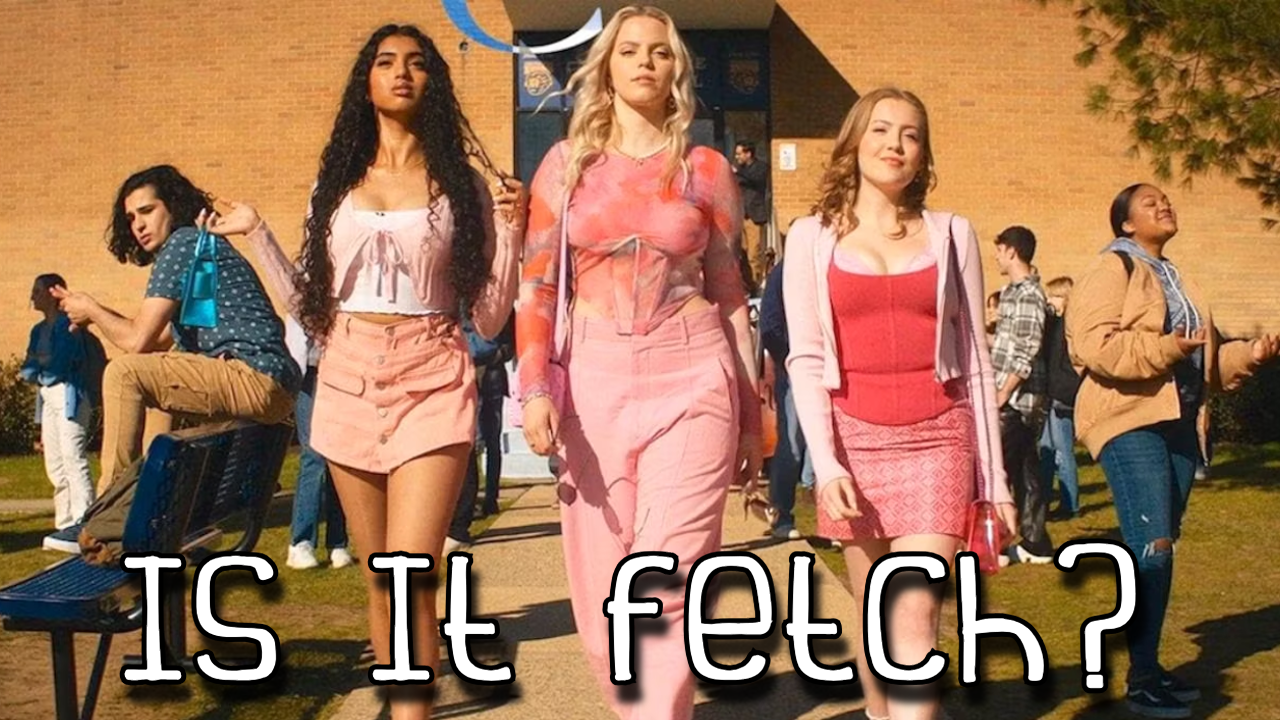
There’s not much to complain about with the casting of either Mean Girls’ movie. The modern trio of Reneé Rapp, Avantika and Bebe Woods feels like a logical evolution of the original. I didn’t understand casting Avantika as Karen until I actually watched the movie and saw Avantika’s perfect replication of the “confused Karen face” created by Amanda Seyfried. You’ll know it when you see it if the original is fresh in your mind.
Casting Tim Meadows and Tina Fey makes perfect sense as they reprise their roles from the original. The acting of both gave it the SNL-sketch feel that gave the original such flavor, and I found myself more interested in whether their characters had any more depth to them than in the original. Placing Lindsey Lohan as the Mathletes moderator was a warm touch that I and my group welcomed with a few “Awww”s and “Oh, that’s sweet”s.
Angourie Rice fits the role of Cady Heron fairly well. At first glance, she doesn’t strike one as the “innocent homeschooled girl” phenotype, but her acting more than convinces the viewer that she is, in fact, a lost teenager in a big new world. Lindsey Lohan was the first Mean Girl to do it, and Angourie Rice is the second. It’s only fitting that she is convincingly the daughter of Jenna Fischer (with both having dyed their hair red) to further sell the point.
Jaquel Spivey went hard in the paint as Damian Hubbard, and dare I say surpassed the already-excellent Daniel Franzese. His take on Damian added a new touch of enthusiasm to the character of Damian Hubbard. Jaquel’s on-screen chemistry with Auli’i Cravalho successfully sold the long-time friendship of Janis and Damian, which I had never really bought into in the original. Were I to award a first place trophy for Mean Girls (2024), I’d award it to Jaquel.
Music
The trade-off of dialogue for music does have its costs as described above, but the writing for the music added a different kind of depth to the show. The lyrics for the music sometimes carries the comedy of the movie, especially if “curing sexy cancer”. That’s a line I don’t expect to be as quotable as the lines from the original, but I wish it were.
The only song whose lyrics detracted from the movie was “I’d Rather Be Me”. While the overall message places Janis back into focus as the main character of the ensemble cast, it dips into an out-of-place feminist message about societal expectations of women versus the expectations men. It’s not clear to me why a movie in which girls are universally terrible to one another and are at a stage of regret for their terrible behavior should have a song about how they ought not “be nurturing and care”. I suspect this song was taken from the Broadway play, which may have had different undertones.
Curveballs
While it isn’t a main focus of the story, the latter half of the movie throws a few curveballs to the viewer that I deeply enjoyed. Three of them come to mind.
The first is the explicit romance between Ms. Norbury and Principal Duvall. This is of course a reference to the Spring Fling of Mean Girls (2004), where they were seen kissing. Through the original movie Mr. Duvall made a handful of unsubtle attempts at Ms. Norbury, so it’s funny to see that they did eventually blossom into something.
The second is Lindsey Lohan’s role as the moderator, who, when the mathlete’s competition comes down to a lightning round, states that “this has only happened once before”. This is of course a nod to Lindsey’s role as the previous Cady Heron. It’s best to not think too deeply into whether there’s some sort of in-universe continuity between the movies, as one would otherwise have to explain why the principals, teachers and students all bear the same names as an identical group of people in that building twenty years prior and why Lindsey Lohan’s character hasn’t connected that the last lightning round was won by a redhead also named Cady Heron (presumably now the Mathlete moderator).
The third is the fourth-wall break during the gymnasium scene, where an actress of East Asian origin (I can’t find her name on IMDB, my apologies – it’s the same actress that appears in the band during the Spring Fling) apologizes for “telling you you were dragging during ‘Revenge Party’ and explaining that there’s so much pressure on them to perform. “Revenge Party” is the song performed earlier by Janis and Damian, and that actress is visible in the musical number. It’s a funny curveball, and if you’re not paying attention you’ll likely miss it.
Is It Fetch?
It stays to the Mean Girls story we all love. It does a pretty solid job of updating the story so it’s believable. It is indeed fetch.

 Amiibo Doctor