

by Doc – Owner, Founder, Happy to be the Guy Who Writes Strategy Guides For Games That Came Out When He Was Five
I grew up playing Civilization IV and its expansions, but as an adult gamer and deeply patriotic man there are few strategy games I enjoy more than Civilization IV: Colonization. “Colo” runs on a modified game engine that is superficially similar to Civ IV, so you’ll see a lot of gameplay elements that are identical, such as:
- Combat
- World Map
- Turn-Based Production
…but many elements have been removed as well. This results in a game that employs some of the same strategies as Civilization but with much more of a focus on micromanaging and logistics. If you prefer long, grand strategies that take place over hundreds of turns then Civ IV is for you. If you prefer something that feels more like a military-industrial complex simulator then Colo is for you.
The most important thing to understand about Colo is that what defines a “unit” is not the same as in Civ IV. In Civ IV, a unit is defined by its unchanging purpose. A Tank has the purpose of being a Tank, always has 28 strength and 2 movement points, and can only be used to attack enemy units. However, Colo doesn’t restricts units to one purpose. Colo operates on a per-colonist basis, where one person can be reassigned to fulfill any number of purposes. You can take a Free Colonist (the standard, generic colonist) and place him into a colony. In that colony, he can work the land, create tools, attend a school if the colony has one or otherwise fulfill any purpose that can be filled in the colony. You can also take him out of the colony and equip him with 50 Tools to be a Pioneer, 50 Guns to be a Soldier, 50 Guns and 50 Horses to be a Dragoon, or nothing at all to be a regular colonist or missionary. The purpose of the unit is flexible and will end up working many different jobs, just like a real colonist would have many different skills.
Additionally, some units have certain areas of expertise. A Master Blacksmith specializes in producing more Tools than a regular colonist, and will produce twice as many Tools while consuming twice as much Ore. An Expert Farmer will produce twice as much Food when working the land. The areas of expertise are fairly intuitive and obvious.
The last major thing for a Civilization player to know before learning Colo is that this game operates heavily on “inputs” and “outputs”.
The Win Condition of the Game
Colo’s games end in one of three ways. You either:
- Lose by all your colonies being taken before declaring independence
- Win by declaring independence and killing every land-based unit the King invades with before the other colonies
- Lose by failing to declare independence and defeat your king first
Colo is very linear: you start in 1492 and have until around 1800 to play. Other colonies will be building their own colonies to declare independence as well. To win, you have to A. Declare independence before they do and B. Beat back the invading force, including retaking all your colonies if the King takes them.
Declaring independence is fairly straightforward: “Liberty Bells” are produced by placing a colonist in the Liberty Bell-producing area of the colony on the colony screen. The colonist will then start to produce Liberty Bells (a symbolic stand-in for “rebel sentiment” – the more Liberty Bells you have, the more rebel sentiment there is) and the “independence percentage” will grow. After the entire population of all your colonies reaches 50% rebel sentiment* you have the option to declare independence from the Revolution Advisor screen.
*This calculation includes units in the overworld, like soldiers. All soldiers and other units in the overworld are assumed to be against declaring independence. It is possible to have every colony at 100% independence but be unable to declare independence because your military are still in the overworld and have not been placed back into colonies. If you’re having this problem, place your units back into colonies.
The Timeline
More specific strategies will be outlined in each section below. These strategies are for lower-level difficulties, as higher difficulties present different opportunities through the game.
The Beginning
- Establish Food colony, build Dock immediately
- Establish Cash Crop colony, build Warehouse immediately
- Obtain Peter Minuit and Pedro Alvares Cabal by focusing on Political Point production in the colonies after producing those two buildings and trading as many materials with Europe as possible
- Buy World Maps off of the other colonies, buy either a Hardy Pioneer from Europe or Tools to make Pioneers to improve the land and build roads between colonies
- Establish Ore colony
- Establish second Food colony
- Establish Lumber colony
- Begin building “Production” buildings – i.e. Lumber Mill, Tobacconist’s Shop, whatever is necessary to increase Hammers production and enhance the purpose of the colony
- Locate other colonies, sell Guns purchased from Europe to the tribes physically located near those colonies. Do not sell Guns to your own native neighbors.
The Middle
- Build up your main 5 colonies and continue refining their production abilities. Construct a Newspaper in each one.
- Purchase from Europe or train through the natives Experts in the areas that each colony needs
- Upgrade Ore colony and a Food colony to be able to produce Tools and Guns with Blacksmith’s Shop, Armory and upgraded versions of those buildings
- Focus on losing reliance on Europe for anything but Experts and Cannons by producing it in-colony instead
- Begin purchasing Cannons from Europe
- Identify native and/or neighbor, prepare for war by parking Cannons next to their colony and having at least one Soldier fortified in each colony in case of counterattack
- Declare war on neighbor – in that same turn, immediately storm every colony with Cannons to kill them as fast as possible (but do not go to war with Montezuma)
- Begin building tertiary colonies in the now-cleared land
- Build Newspaper in the tertiary colonies, build Liberty Bell-producing buildings in the big 5 colonies. Remember not to place colonists in Liberty Bell-producing roles until the tipping point in the Late Mid-Game.
- The focus of your colonies is now to produce money, Guns and Population. The money is to purchase Elder Statesmen from Europe en masse. The Guns are to arm your colonists en masse. The Population is to have colonists to arm.
The Late Mid-Game – Preparing for War
- Run your colonies accordingly, placing Elder Statesmen in non-Liberty Bell producing areas as regular colonists.
- Begin having Pioneers chop down the forests on your coastline.
- Build Wagon Trains to store 200 Guns each in the big 5 colonies
- When you reach enough Elder Statesmen to have 2-3 in each of the big 5 colonies, place them in Liberty Bell-producing positions all at the same time. This is the “tipping point” where the colonists must aim towards war instead of production. In the tertiary colonies, place at least one person in the Liberty Bell production slot, preferably two if you have enough population.
- Your economy will heat up significantly over the next several dozen turns due to the universal multiplier effect of Liberty Sentiment. Use the money from increased production to purchase more Elder Statesmen and more Expert population as needed.
- Continue stashing Guns and Horses in Wagon Trains until each colony has enough Guns to arm at least half of its citizenry at a moment’s notice. Each Soldier requires 50 Guns (for most leaders) and each Dragoon requires 50 Guns and 50 Horses.
- Rinse and repeat until your Liberty Sentiment is at 50% for the entire population (see the Revolution Advisor in the top right to check). If you’re finding it difficult to raise, remember that the game tracks every out-of-colony unit as preferring not to to have independence, so placing them in colonies should help the overall sentiment after a few turns. If you’re before 1700 and it looks like the other colonies aren’t close to declaring, you might let it continue to build while you produce more population and Guns.
- When rebel sentiment hits 50-70%, arm your colonists, place them on the coastline and fortify, and declare independence.
The Late Game – Wartime
- You’ll declare independence and be asked to write a Constitution. This is when you get to select your “civics” of the new country you just founded, but you can’t change them later. Choose these:
- All Men Are Free (seriously, don’t pick Slavery)
- Elections (the overwhelming navy of the King will murder any ships trying to trade with Europe anyway)
- Native Rights or Manifest Destiny is up to you and whether you want to run the risk of going to war with natives during your revolution – Native Rights is probably the safer option
- Separation of Church and State and Theocracy is up to you, Theocracy is better for Hammers production but Separation of Church and State is better for maximizing your Liberty Bells multiplier which also impacts Hammers
- Right to Bear Arms (makes every colonist stronger)
See Wartime section below.
The Beginning
Leader Selection
In Colo, the Spaniards are far and away the best leader to choose. Jose De San Martin’s Resourceful trait requires units to have half as much experience to be promoted, and his Conquistador trait gives him a 25% boost against native units. This man is practically unstoppable by native forces, and colonial forces have a difficult time against him as well so long as he has a unit or two with experience. Defeating the Spanish usually requires twice as many units as would normally be required against the other leaders’ colonies.
The Brits are often the second-best strategy due to John Adam’s 25% Liberty Bell production bonus. Liberty Bells are the most impactful production multiplier in the game, and are difficult to obtain quickly but are still mandatory to win. As you’ll see in later chapters of this post, the optimal revolution strategy is to minmax your Liberty Bell production: spend the first 60% of the game building up your colonies, then hit a “tipping point”, turn on a dime and blast your cities with Liberty Bell production to declare independence as fast as possible before the King can build up his Royal Expeditionary Force. John Adams is helpful in this strategy, but not required.
The Brits both have Tolerant, which results in faster European immigration. However, this boost is not as beneficial in the mid or late game when your colonies can produce more units than Europe.
The French are mostly useful as a niche, fun strategy where one consistently interacts with the natives in a trade, conversion and educational capacity. The French get significant relational boosts with the natives, but such boosts often aren’t as helpful compared to simply having a few more cannons and soldiers to clear out natives. The French are a useful leader to have when settling next to Montezuma or Huayna Capac, both of whom are rather prone to going to war. They tend to suffer what we call “annihilation” when warring with the King, though.
The Dutch benefit heavily from trade with Europe, but the Dutch are only viable as a leader if one’s colonies are heavily expansive and significant investment is made into the commercial and economic side of the game. Unfortunately significant economic capacity is rarely helpful when the natives declare war on you, and they are more likely to do so as you take up more land. Natives aside, it’s difficult to convert economic horsepower into military and population horsepower as fast as one would like, and the win condition of the game is only met by military and population horsepower. As a result, I rank the Dutch as the worst leaders in the game unless you’re focusing on making a lot of money to build up massive mega-colonies that pump out Guns and Food like crazy while the minor colonies produce the economic products (which isn’t a good strategy).
Choosing Where to Settle and What Colonies to Build
The normal Colo game features a randomized map with unpredictable layouts besides having more bountiful “warm tiles” in the middle such as Tobacco and Cotton, and “cold tiles” in the North and South such as Fur. Placement of mountains and hills is probably random. The New World map will usually be one central landmass (think “Pangaea” from Civ IV, but about twice as tall as it is wide) with a few odds and ends, while the Caribbean map will have significantly more islands and a smaller central landmass, and less yielding tiles. Do not settle on islands if at all possible, as they are difficult to operate logistically, more difficult to defend and even more difficult to make productive. (Personally, I think Caribbean is twice as hard as New World, and half as fun.)
In every Colo game, I end up with at least 5 colonies by the end of Turn 100, and then typically found 5 more colonies about 30 turns before declaring independence. Those first 5 colonies each serve a purpose, and I name my colony according to its purpose. Because the win condition of this game (military victory) requires only Guns and population, I prioritize the long-term ability to produce Food and Guns as a result. It’s important to remember that when a colony hits 200 Food in storage, it will automatically delete that 200 Food and produce a Free Colonist.
These are the 5 colonies that I always build:
- 2+ primary “Food” colonies, situated near high-food land or water tiles. The focus of this colony is to churn out population, Guns and Horses towards the mid-game. These colonies end up being the backbone of your military but tend to sacrifice high Food production for Horse production later on. It’s typically best to place these on the coasts because Expert Fisherman are high-producing Food units.
- 1 secondary “Lumber” colony, situated near forests to produce lumber. The focus of this colony is to produce Hammers that may be used to churn out Founding Father Points, Cannons, Wagon Trains, etc.
- 1 secondary “Ore” colony, situated near Ore tiles to produce high quantities of Ore for Tools and Guns production. The focus of this colony is to eventually be your most productive Guns production.
- 1 secondary “Economy” colony, situated near a cash crop (Tobacco/Cigars is preferred for its price stability, but Silver works too if you find 2-3 Peaks – just don’t rely on Silver for the entire game). The focus of this colony is to make money, and eventually to establish a school in the colony once the sale of that good is banned in Europe so that you may produce Experts in production of other goods.
Once I’ve made my way through the middle portion of the game and am starting to establish my Liberty Bell production capabilities, I keep an eye out for the shortcomings that my main 5 colonies have. Are they short on Lumber or Ore? Are they surrounded by unimproved tiles? Is the good/s that the Economy colony produces crashing in price or able to be traded at all anymore? Once I’ve spotted these issues that’s when I start to churn out a few tertiary colonies specifically to address those problems. Be sure to keep a handful of pioneers so you can always use the “Improve Nearest City” function and have them do the work for you. Just don’t let them near forests, as they’ll automatically cut them down.
My tertiary colonies typically are:
- 2 more “Food” colonies because the original Food colonies can’t produce as much anymore now that they’re building Horses.
- 1 more “Lumber” colony that remains low in population, usually surrounded by dense forests.
- 1 more “Ore” colony, solely to generate Ore to ship into the former “Ore” colony and the former “Food” colonies.
- 1 more “Economy” colony that focuses on a different cash crop than the previous one.
The tertiary colonies typically don’t break 8 population, and are most useful as an easy way to generate Liberty Bells in the late game.
You’ll find that your Food colonies tend to up with the most population, and therefore the most production capability. Because of that eventuality, I typically end up assigning Tools and Guns production to one Food colony (because it can support the most colonists) and Horses production to another. I use Wagon Trains prolifically to keep the Food colonies supplied with everything while the secondary
It’s vitally important to use Expert Farmers and Expert Fisherman in your Food colonies, and to build Docks and Drydocks to maintain Food production as your population expands. Use a Pioneer to turn high-Food tiles into Farms for greater Food production. The whole reason you need to make money is so you can buy these units!
Be sure to space out your colonies so that each one has access to all 8 tiles around it – otherwise you’ll find that your colonies often starve or are unproductive. Unfortunately this often means that natives and other colonizers are too close to you, and may declare war on you as a result. We’ll discuss how to pre-emptively remove them in the “Combat” section.
Seasoned Scouts and Pioneers
If you’re really lucky, one of the first units ready to immigrate from Europe will be a Seasoned Scout. The first thing I do in a new game is to check if a Seasoned Scout is one of the three units who might immigrate to Europe next. I always spend whatever money I have to hurry the Scout if that’s the case. Starting the game with a Seasoned Scout is the single best “first 10 turns” strategy you can possibly have.
Once you get the Scout to the mainland, simply drop him off on the biggest landmass and have him “Explore” (the mountain button). He’ll automatically go to every tribe and ancient ruins, and scout out the entire continent until there are no more tiles left to uncover. Sometimes the ruins will give him experience: always go with the two Navigation promotions that give -1 Terrain Movement Cost and +1 Visibility first, as they let him cover more ground much faster.
The Scout will sometimes get Treasure units. Park these units at a coastal colony, and just let them sit until you can afford or build a Galleon unit to carry them to Europe. Don’t let the King do the shipping for you, it’s not worth it.
Pioneers are also incredibly useful for the early game, as they improve your production by improving the land around your colony. Pioneers can be created by colonies that have 50 Tools available, so make good use of them while you can! I always make sure to connect my colonies with roads so Wagon Trains can ferry needed goods much faster once I have them later. It’s also useful to clear out all forests that you don’t plan on using for Lumber, as enemy native soldiers are most vulnerable in unforested and unhilled tiles.
Founding Father selection
There are five kinds of Founding Fathers points: Trade, Exploration, Military, Religion and Political. Political Points are required for every Founding Father, while the rest of the points are obtained either through their respective activities or by having a colony convert its production into those points.
There are two Founding Fathers that are absolutely necessary for long-term success in Colo: Peter Minuit and Pedro Alvares Cabal. Peter Minuit drops the cost of recruiting units from Europe by 25%, allowing you to purchase ships, cannons, Elder Statesmen and the like for dirt cheap in the late game. Unfortunately, he’s often the very first Founding Father to get grabbed up, so it’s vitally important to have your first colony build Political Points while your second colony builds Trade Points, and for your lone ship to be selling raw materials to Europe as fast as possible to build more Trade Points.
Pro tip: in your early turns, if you have about 300 gold, go to Europe and buy 100 Tools. Then sell it to any old native for 437 gold (it’s basically always this price the first time you sell to a native). You pocket 137 gold, get some Trade Points out of it and you put your Caravel to good use.
Pedro is an Exploration Points Founding Father, and will require Political and Exploration Points. Those can be obtained by uncovering new tiles, and if you are lucky and obtain a Seasoned Scout from Europe early on you’ll often get Pedro by accident. However, if you don’t get a Seasoned Scout early on, you’ll need to build Exploration Points using a colony and by having an otherwise-useless colonist explore the contintent on foot. Pedro is vital to trading with Europe in a timely manner as he cuts 2 turns off of each trip to and from Europe, and that adds up significantly over the course of the game.
Treasures
If you’re the first colonizer to contact a native settlement, they’ll give you a “Treasure” unit. When the Treasure unit is first placed into a colony, the King will offer to give you an instant payout for half the Treasure’s value. Don’t take it unless you know you won’t have a lot of Treasures. The best players hold onto their Treasure until they can afford a Galleon, and then buy a Galleon to transport and sell the Treasures with. This results in being a few thousand gold better off than you otherwise would have been, and I use that money to fuel purchases like Silver Miners.
Midgame Strategies
Your midgame is really all about setting up your endgame. During the midgame, your goal is threefold:
- Expand your population
- Expand your industrial capacities for Ore, Tools, Guns and Horses and expanding commercial capacities to fund Liberty Bell production
- Expand your Liberty Bell production to declare Revolution
I consider the midgame to be the period from when the fifth colony has been established to when you declare Revolution. This is the real meat of Colonization, as the game changes from being an exercise in settling the New World to more of an economics and logistics simulator.
Expanding Population
There are only three ways to increase the amount of Food you can get from a tile.
- Expert Farmer or Fisherman
- Farms (if on land)
- Dock/Drydock/Shipyard (if ocean tile)
There’s a few other mechanics to be aware of when building Food. First, each time a colony’s Food storage hits 200 Food stored, it automatically produces 1 Free Colonist. This cannot be turned off or reverted. (Endgame note: I use Wagon Trains as excess Food storage so my colonies don’t starve when they’re surrounded by King units.)
Second, Food is also the input resource for Horses. If you’re finding that your Food colony isn’t producing much Food, it’s because it’s all going into Horses.
Third, each population eats 2 Food per turn. It’ll cost you 6 Food per turn just to have 3 Elder Statesmen, so consider the pace of your colony’s growth compared to its ability to feed itself.
The ideal Food colony will have an Expert Farmer or Fisherman working all 8 surrounding tiles if possible, and will be surrounded by Farms when possible. Cyrus McCormick, a mid to late-game Founding Father, boosts nearly all tiles’ Food production by +1, proving to be vital for Food colonies that use Experts. If all 8 tiles are boosted, and the Experts double the production, then the result of Cyrus is a +16 Food per turn in that colony.
Expanding Industrial Capacities
This is the tricky part of Colo. You generally want to settle colonies that have enough food to feed themselves, and the only real exception to this rule is a colony that is situated to produce very good commercial returns i.e. no food production but it’s incredible for producing Fur, so you build the necessary buildings and truck in Food periodically. There’s always the option of settling on the Coast so you can at least import Expert Fisherman to stop most of the bleeding while the commercial products are made. So for example, let’s say you have a colony on the coast in the very southern icy part of the map that’s ideal for producing Fur (two great Fur tiles) but nothing else. You’d bring down your Expert Fishermans, your Expert Fur Trappers, your Master Fur Traders and the necessary Carpenters and lumber to build the buildings needed to produce Coats. Yes, you’d have to periodically bring in Food from another colony, but at least your Fisherman can keep it sustained and you’re producing major profits.
Don’t forget that you also need at least one colony that can produce very large amounts of Ore and Tools, and that that colony will need to build a Blacksmith’s Shop, Armory and at least an Ironworks (but likely also a Magazine) to produce enough guns for victory. I often combine that role with my Food colony and just import the Ore from an “Ore” colony, because the Food production can support the Blacksmiths and Gunsmiths already.
Your industrial expansion will be mostly fueled by Carpenters, who are fueled by Lumber. This part of the game is why your Lumber colony is vital: without Lumber, it will take dozens and sometimes hundreds of turns to complete even a single building. If you can keep the Lumber coming to and from the colonies with your Wagon Trains, they’ll spring up pretty quick. (Alexander Hamilton does help with this tremendously).
When it comes time to sell your commercial products (Cigars, Cloth, Coats, etc.) you should always hitch them on a Wagon Train or ship and try to sell the goods to natives before selling them to Europe. It’s okay to sell to Europe in the early game because that gets you Trade Points and Europe has an infinite supply of money, but each native leader has a limited amount of money that can be obtained. The advantage of selling to natives is that Europe can’t tax it (though they’re aware of your tax rate and will price it out accordingly). It’s sometimes better to accept a lower price with the natives to 1) build a relationship with them and 2) save time and ship space. Just be aware that natives don’t care about “natural” products like Silver, Lumber or Furs, so you’re going to be outta luck if you can’t sell them to Europe. However, you can also buy Silver from natives for dirt cheap, so if you’ve got the space on your return trip, buy what you can!
Screwing With Opponents
Colonization would be a much easier game if you didn’t have opponent colonies who are also interacting with natives, trying to get them to kill you, and racing to independence. You can screw with your opponents in a few ways:
- Selling Guns to their immediate neighboring natives
- Paying natives to declare war on other colonies
- Going to war with other colonies directly
#1 and #2 are great options, and I do them every game. See, when a native colony gets a hold of Guns they’ll convert their Brave units into the much stronger Armed Brave units. You’ll find it incredibly helpful to pick up a few hundred Guns from Europe, sell them to an aggressive native (so long as he is not your neighbor) and then paying that native to go to war with their neighbors. Pro tip: Montezuma is loaded, wants Guns, and is willing to go to war for a price. You’ll make great money selling to him, and may even triple your investment if you hit the right colony.
Be sure to have a Scout run through the colonies ahead of time to find out what they want; if you can do that, you’ll get vastly more money out of your Guns.
Natives are much more hateful to you in the higher difficulty levels, and they’ll often outright refuse to go to war with the French, but if you can get someone like Montezuma, Mangas Colorados or Huayna Capac to go to war you’ll find that they stymy your opponent quite well. The best part is that you can sell Guns to everyone who isn’t your neighbor.
Liberty Bell Production
Liberty Bells are a serious investment in Colo, but they’re also required to win the game. At first, investing in Liberty Bell production is nothing but a waste of Food and an otherwise-useful colonist. It isn’t until you start to see the colonies’ Rebel Sentiment (the blue bar just above the resources on the Colony Screen) hit ~25% that you realize just what it does: as the colonies’ Rebel Sentiment increases, so too does its resource production. If the 25% of the colonists support independence, then everyone’s output is increased by half the percentage of support, rounded down. This doesn’t sound like much, but consider this scenario where you have:
- 12 Ore yield from the tiles
- a Blacksmith producing 12 Tools, consuming 12 Ore
- a Gunsmith producing 12 Guns, consuming 12 Tools
Then the 12 Ore will become 13 Ore produced because it’s a 12% multiplier. The Tools will still consume 12 Ore, but produce 13 Tools instead. The Guns will still consume 12 Tools, but produce 13 Guns instead. The difference between a colony with 0% Rebel Sentiment and a colony that has 25% Rebel Sentiment s a gain of +1 Ore, +1 Tools and +1 Guns per turn. If you bump that Rebel Sentiment up to 50%, then it becomes a 25% gain of +3 Ore, +3 Tools and +3 Guns per turn. This applies to everything being produced: Food, Hammers, even Liberty Bell production. The game’s economy is designed to be a real slog until you begin Liberty Bell production.
You can and should increase Liberty Bell production by purchasing Elder Statesmen from Europe (you can technically train them in-colony with a University, but only if you already have one in the colony and it will still take ~20 turns) and by building Printing Presses, Newspapers and the third-tier building for resource production. That is to say, after you’ve built the first two Cigar producing buildings (Tobacconist’s House and Tobacconist’s Shop), the final building – Cigar Factory – will come with a +25% boost to your Liberty Bell production.
Make no mistake, you need to start producing Liberty Bells at least 100 turns before you want to declare independence. It takes a while to make them, and they don’t really pay off until you start producing more Guns than you know what to do with. However, you can’t start producing them too early because the King will periodically add units to the “Revolutionary Force” the longer someone is producing Liberty Bells. That’s why we min-max them: it minimizes the amount of time he can add units, while maximizing the gains as fast as possible.
The Late Game – Wartime
At this point winning the game simply comes down to battle tactics and surviving to the next wave. The King will usually make landfall within a few tiles of the first colony you placed down, and will blanket the coast. Use your Dragoons to kill their Cannons. Keep most of your Soldiers fortified on the coastline and park a few in the colonies to defend them*, occasionally poking their heads out to pick off units they have an advantage against. Use the Cannons you bought a few hundred years ago to re-capture any cities that are taken. Do not bother with ocean battles – the king’s navy outclasses yours by so much that I’m not even sure it’s possible to win the ocean game in a vanilla game of Colonization on a game with real difficulty.
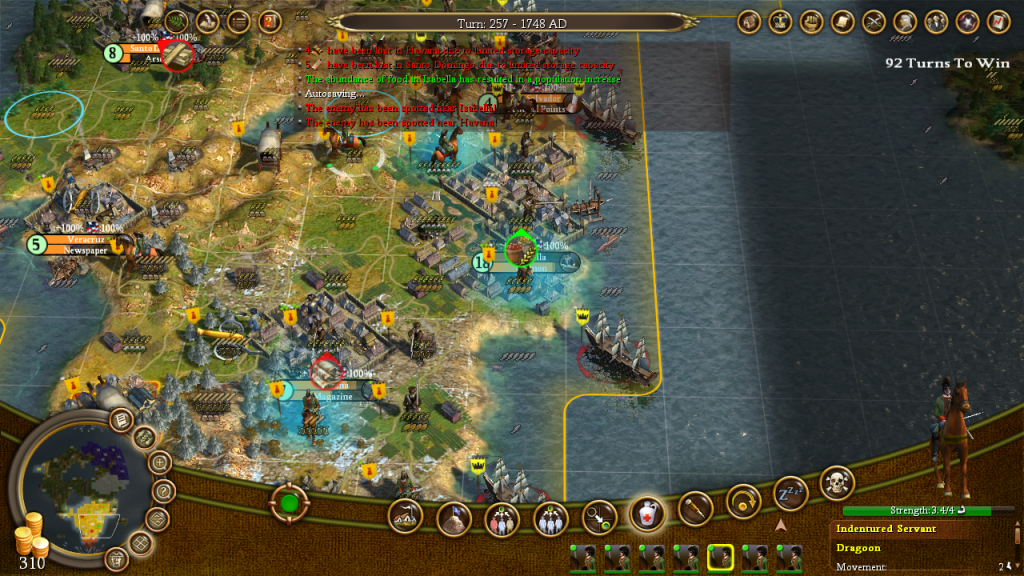
*Coastal colonies need a few extra Soldiers for when the King directly attacks from the boat.
When pulling out colonists to use as Soldiers, leave in the colonists who are:
- Food producers
- Guns/Tools producers
- otherwise necessary to ensure the colony keeps producing Guns, Food and Tools. It’s up to you to continue producing Horses or not, as Dragoons win games but generating extra Soldiers may be more useful
Everyone else, including Elder Statesmen, can be used to fight save for Converted Natives, who can only defend. Be sure to park Dragoons within one turn’s distance from most of the coastline, and to park most of your Soldiers all up and down the coastline. I encourage players to hold the coastline with Soldiers for as long as possible as it prevents the King from getting a foothold from which he can start to use real battle strategies. That’s why I had you cut down the Forests on the coastline – it limits his defensive bonuses without limiting yours. If a spot on the coastline breaks through, kill whoever broke through with a Dragoon and then retreat the Dragoon before moving new Soldiers onto that tile.
Combat Mechanics
Hopefully you’ve kept the units from your first war who have combat experience, as they’ll be vital for this war. Because the experience belongs to the person, not their combat role, you can change a Soldier to a Dragoon and vice versa if needed (though Cannons can’t be change, as they are considered “built” units like Wagon Trains and not people).
When fighting, remember the roles that each unit has:
- Cannons are specifically for attacking cities, and they’ll win most of their offensive fights against cities but are very vulnerable to mounted units. Assume that each Cannon/Artillery parked next to a city equals one unit lost in that city each turn until it’s killed.
- Dragoons are cannon-killers and are also your “rush” units that pick off lone Soldiers and weakened Dragoons out in the open. Dragoons that have Veteran II can promote to gain +25% against other Mounted Units, making Dragoons mandatory for beating other Dragoons.
- Soldiers are your city defenders as the only unit that can Fortify, but can also be flexible in their promotional structure, letting you customize them to defend against cannons or Dragoons more effectively
The King on higher difficulties has unique units that are stronger than yours. Artillery are stronger equivalents of Cannons, and Regulars have one more strength point than your Soldier or Dragoon equivalent (for some reason the game calls both of them Regulars). Each King unit is one strength point stronger than your own (though this can be mitigated with good Civics choices) so higher difficulties will require you to strategize more heavily regarding which units you use to counter them.
Unlike in production, Indentured Servants and Petty Criminals don’t have any performance detriments, so you can use them as soldiers just the same as you would a normal unit. However, Converted Natives can only defend.
Great Generals are created as your units gain experience points from combat. They grant 20 experience points total, spread across every unit they share a tile with. I recommend pulling aside a Soldier, using the General on him, and then dropping a Veteran I + the three Medic promotions to make a “Medic” unit, then placing him in a city. That way the units in the city will heal way faster and can fight again very quickly.
Colony defense points (the defense you gained from buildings Forts and the like) are largely irrelevant against the King, as his Man-o-War will destroy your defenses very quickly. They’re useful for stalling, as he won’t invade you until he’s destroyed your defenses in most cases, but that’s all they’re good for. Defenses are only good for fighting off natives, who don’t have cannons and thus tend to suffer against good defenses.
King’s Strategy
The King’s strategy on higher difficulties is simple: overwhelming you with numbers is his big strategy, and on a turn-by-turn level he’ll be calculating the best attack odds at every turn and exploiting those. His forces will be physically spread out over the countryside very rapidly if given a foothold of even a single tile, leaving you with very few strategic options besides sitting in your colonies and trying to weather the storm.
You won’t be able to weather that storm because he’ll bombard away your city defenses, and then flood cities pretty rapidly. That’s why we fight for the coastlines as long as possible: it prevents him from taking the strategic options and forces him to focus on taking single tiles. Your best strategy to counter this is to fortify your soldiers on each tile of coastline and keep your Dragoons in the back to pick off anything that manages to make landfall. Your Dragoons are really the offensive superstars of this game, whereas your Soldiers are there to benefit from the fortify bonus and have mild promotional specialization.
Be advised that the King always invades from the East, and will usually initially target the colony you put down first at the beginning of the game unless you have colonies that are significantly more eastward, in which case it’ll alternate between attacking your first colony and your eastward colonies. The AI tends to fixate on putting down stack attacks onto single, specific tiles so once you learn which tiles it wants to place them on you can focus your forces there.
What about Veteran Soldiers?
Veteran Soldiers are just normal Soldiers but they come with a few extra promotions, like Strength 1 and a settlement attack boost. If you’re really desperate for a soldier and for some reason can’t buy Guns, then I suppose you could spend the 1500 coins for one. However, it’s really better to simply not sell your Guns to Europe so they can’t ban Guns trade, and only buy Guns to sell to natives or when you absolutely need to. Then use your Guns to convert a non-Soldier unit into a Soldier unit.
What do the Colonies Do in the Meantime?
You’re in a state of war, so you can ditch economic production now. Your colonies exist to pump out soldiers alone. Be sure to leave around 200 Guns physically in the colony (not in a Wagon Train) so that if the colony is attacked, up to 4 of your population can automatically take up arms and defend against it. If you expect to be attacked in the next turn, then just dump all your Guns into the city so every colonist can arm. It’s usually better to try to anticipate these attacks and have the colonists take up arms ahead of time, but when you’re in a pinch you need an auto-response available. I also recommend parking Converted Natives in colonies you anticipate will be attacked as they can still defend with their 2 Strength points.
Conclusion
That’s basically it! Once you’ve killed every last non-ocean unit the King has, you’ve won the game. Make no mistake: Colonization is much harder than normal Civ IV in my opinion, so if you’re a Deity-level Civ player you might find it best to take it down a few notches in Colo at first. It’s a unique game unto itself.
Hopefully this helps!

 Amiibo Doctor