

by Doc – Owner, Founder, Scratching His TCG Addiction in the Cheapest Way Possible
See also: Are Graded Cards Worth the Risk?
Running a successful card shop in Card Shop Simulator, as with most sim games, is about building a store that’s not going to go broke before it unlocks the fun stuff in the game. It’s a great combination of that horrible “I need to open 1,000 booster packs to satisfy my gambling addiction” and “I like sim games” affliction that we all struggle with. Of course, this guide is NOT a min-max guide, as there are plenty of those on the internet already. I’m assuming you know the basic mechanics of a Trading Card Game, i.e. booster packs, singles, booster boxes, and the basics of a sim shop game like how to sell one’s products.
Note: If you’re not looking to get super deep into “sim game” strategy, this guide is still helpful for you. TCG Card Shop Simulator is a perfectly enjoyable game even if you don’t like to min-max things and try to optimize every aspect of your store.
Table of Contents (click to drop down):
- Your First Days: Employees, Levels and Booster Packs
- The Mid-Level Strats
- Late Game Tips and Tricks
- The 8:00 AM Trick
- How Customers Shop
- The Single-Item Strategy
- Basic Pricing Strategy
- Inventory Diversification Strategy
- Advanced Customer Behavior: Weekly Target Item Lists and Customer Percentage Scaling
- “Customer Slots”
- Card Rarity: Drop Rate Mathematics, Foil Variants, and Ghost Card Mechanics
- Customer Trading Dynamics and the Math Behind Them
- Stink Mechanics, Crowd Control, and Automated Cleaning Systems
- Card Table Mechanics
- Tournament Management
- Purchase Decision Mathematics
- How Experience is Calculated
- Conclusion
Your First Days: Employees, Levels and Booster Packs
This game is basically a “player does everything by themselves” game until you hire an employee. You run the checkout, order items, stock them, and so on. The tutorial will walk you through all that pretty quickly.
The big “hustle” in the beginning is just processing customers, stocking all the booster packs and boxes you can, and keeping the checkout lines short. Don’t spend money on physical store expansions until you’re at least level 15, and when you do buy expansions, buy as many as you can at a given time (more on that later). Same thing with employees: employees turn the game from a micromanaging simulator to a more AFK experience, which changes the pace of the game quite a bit, as it becomes less of a hustle simulator and more of a strategy simulator, so wait until you’re doing about a thousand bucks a day of revenue before hiring one. I encourage putting your first guy on the checkout counter so you’re free to restock as needed, handle trade requests and restock singles if you’ve got the table for it.
I’d always encourage you to, if you’re playing without mods, take a few levels and build up your store to at least the third tier of booster pack before opening booster packs en masse. It’s just more fun that way. Having a fat wallet in the early game is broken as hell because you can exchange your money for booster packs and booster packs for money and XP, and once you hit level 20 (I think it’s 20) you can purchase the booster pack machine that converts your money into singles cards and XP. However, booster packs are high-risk high-reward until you get to opening thousands of them at a time (but the machines to open them while AFK are quite expensive), at which point you’ll basically always make your money back on them. Boosters are great XP, but levels come quick in the early game and you’ll get more mileage out of the money you’d spend than the XP anyway. Hence the recommendation to wait until level 20.
You get more XP opening booster packs by hand than by machine – like, a lot more XP. Probably 20 times more XP. So it may be worth it to just sit there and open boosters for a bit if you can afford to once you’re out of the early game.
So if you shouldn’t hire employees or open boosters at first, what should you do? Simple. Sell. You’ll have more space than merch at first, so buy a card table and some shelves, and keep as much merch stocked as you can. Your turnover will eventually create a nice cash flow allowing you to unlock better and higher-profit products, and you’ll get XP as well. Just play it like a normal retail sim.
The Mid-Level Strats
Now we’re getting into How to Make Money. Glance over this guide if you have any questions as to what to do.
Certain purchases should take priority at the first available opportunity, specifically auto-scent machines, which should be the top priority in all games. Start with two machines at your main entrance since the second one covers customers entering while the first is on cooldown, and add two more when you buy the “B” lot. The thin, tall machine that only takes up one “square” is fine for this, and it holds two “Cleaner” accessories so be sure to check daily for needed restocks. Once you’ve bought those you’re fine for a long time.
As of the 0.65 update you can now task an employee with keeping the scent machines refreshed, by the way. I always purchase a pack of 16 whenever I’m buying new product, and stock it in the shelf I have specifically for the deodorants, so the employees can take it from there.
Hiring and Primary/Secondary Roles
The 0.66 update reworked employees’ behavior. Employees serve two primary functions:
- Restocking merch and cards
- Manning the counter
Your most valuable employee is the one manning the counter, because manning the counter takes up most of your time during the day and the faster they get customers out the door (meaning that customer slots are now empty) the faster new customers can come in. Always hire the fastest checkout speed employee you can afford. The checkout counter is your top priority for all employees. Don’t set a secondary task for the counter employee, they need to be there at all times to keep the line moving.
After that, restocking is your next problem, but that one you can cheap out on without much issue most of the time. It rarely takes more than five minutes for an employee to restock most of your store, so every few days just use the 8:00 AM Trick (see below), go AFK to let him hang out and restock before opening the store for a few minutes and he’ll be caught up on everything pretty quick. AFK time is very helpful in this regard.
Once you unlock the Card Storage Shelf, your employees can restock singles cards into card tables. This is huge, so it’s a worthy goal to aim for in the early game. After you get it, have your merch-stocking employee restock merchandise as their primary role and restock singles as their secondary role.
Run Card Games?
The 0.65 and 0.66 updates modified the AI for card tables so that the customers will find tables better, and a sitting player will not take up a customer slot, which removes an inherent penalty for using card tables, and makes them a bit more effective than they were. They can also charge more as your store rating goes up. That’s great!
The problem is that card games still just aren’t going to make nearly as much money as simply selling goods or gambling with card packs. They’re a fine all-profit source of revenue in the beginning, and with ten tables running the maximally expensive tournament you may even pull in six to eight grand a day in the late game, but that’s just not going to cut it compared to your costs of doing business in other areas. You can run a store entirely off of card tables if you have no employees, it’s just… why bother? Singles cards are more interesting anyway.
Use card tables when you have space that you don’t see a need to fill. Otherwise, don’t mess with them.
*”Customer slots” is the game mechanic where you can have a limited number of customers in your store at a time. The limit increases with every expansion you buy and with your store level.
A Second Checkout Counter
A second checkout counter becomes worthwhile once you can hire two workers, preferably the fast ones. While checking out customers is pretty easy and fast for a human to do, you’re also going to be restocking shelves and single cards, adjusting prices, etc. when you need to be checking out customers. Consider hiring a worker for your checkout counter to cover your butt in that area. Fast workers process customers more quickly, allowing you to have more customers in a day, though be aware that most employees leave at 9 PM no matter what (except for the last two on the phone) potentially leaving you to handle late customers manually. If deciding between a restocker and a checkout counter, just know that you’ll easily be able to obtain both eventually but checking out takes up more of your time in the day. I always start with the second checkout counter for that reason.
Regarding Booster Packs…
A lot of the content that you’ll see about TCG Card Shop Simulator comes from previous iterations of the game where most players just wanted to “min-max” the game, which consisted of just stocking the most expensive booster box and not selling any singles. For this reason, booster packs have been seen as too risky.
I think that given the availability of fast pack open mods and the 0.62 introduction of the pack opening machines, singles are actually quite viable beginning in the midgame if you can afford the pack opener machines, and hunting for them becomes significantly more financially viable if you have the workbench to liquidate otherwise unsellable cards. Grading cards on average increases their value by about 15-20% (that’s including the good grades and the bad ones), so if you’re grading a card that would make up for the expense of grading, then singles become quite the cash influx.
I found that when opening boosters and selling the singles, I had basically three tiers of card pulls. I had the super-rare “high-value” cards that were worth 100x the value of the pack I pulled. I had the middle-rare “medium-value” cards that were worth 10x the value of the pack I pulled, and the rest were the commons that you’d fill a commons box with. You’ll make your money back by selling the medium-value cards so long as you open enough boosters, which you can easily do thanks to the automatic pack openers that are available after the update, and selling bulk boxes gets you a little bit of revenue from the commons. It’s the high-value cards that tend to generate your profits from opening packs, so you’re shooting for those. Just be warned, you will have to open a few thousand of them to make serious money. It’s not as expensive as you think, it just takes time.
You can partially automate this by having employees automatically load the card machines (as of 0.66) which only requires you to keep restocking cards and collecting the ones for sale, then depositing them into the Card Storage Box. It’s a cycle: Order booster packs, get the cards from them, sell the cards from them, order more booster packs.
The Workbench
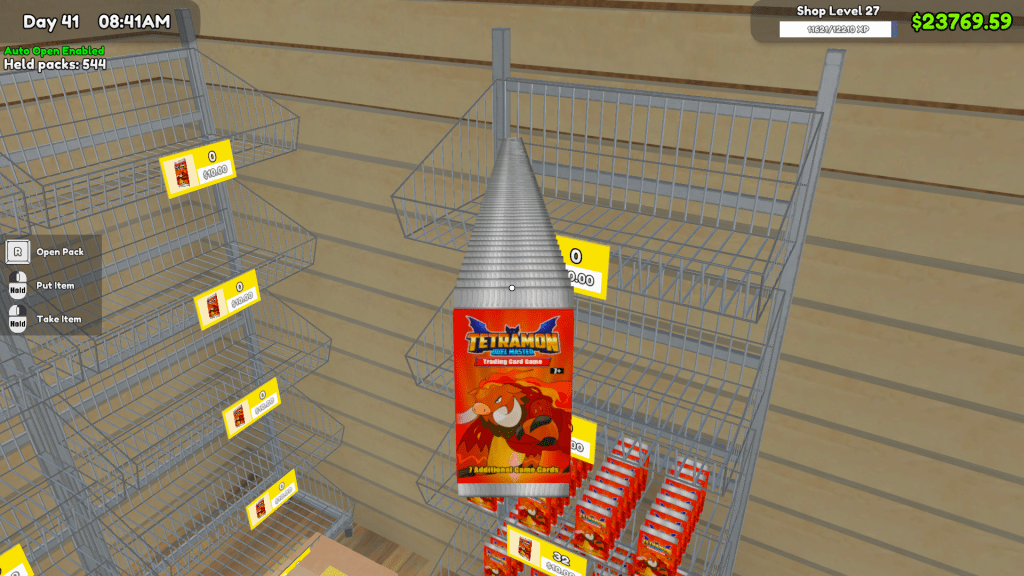
You want to start using the workbench earlier depending on how many boosters you’ve opened. The workbench’s purpose is to basically take all those low-value cards that you’re never going to be able to fit onto a card table and sell them en masse at a discount through bulk boxes. The workbench was just updated in 0.63.1 to include a new tier of bulk box too, so your $5-$20 cards can get liquidated as well. That update took the workbench from “worth it” to “Really, really good” because it stops you from having piles of unsold cards that you’ve paid for, but can’t liquidate into cash. In other words, it raises your average revenue per card pack opened by a lot. The only real downside is having to manually make each bulk box, which takes about ten seconds each.
Late Game Tips and Tricks
Alright, you’ve hit around level 45 to 50 and you’re finding yourself in the late game. Money isn’t as tight, customers are plentiful, you have at least two employees and a few pack openers working for you all the time. Now what do you need to know?
The 8:00 AM Trick
I just discovered this last week. If you have employees whom you’ve already hired and told to restock shelves, and wait at 8:00 A.M. for them to come in and restock the shelves, they’ll do it even without you starting the day. This means you get free labor out of them, can AFK your shop a bit more and that way you don’t have to help restock the 60+ pile of boxes you’re normally having to help with. This ends when you flip the sign over and the day starts, at which point the game continues normally.
I use this a lot in the lategame because I have 6 restocker employees and typically a few hundred boxes that need stocking every few days, so leaving the game running for ten minutes or so helps cut that down to size. Customers will buy whatever you have on shelf faster than it can be restocked, so having that extra time to restock is basically a necessity.
How Customers Shop
Regular customers make up about 95% of your foot traffic and have spending power that scales with your shop’s level and size progression. At basic levels, they might carry $500-1000 at most, rarely bringing out that kind of money, but as you level up and expand, regular customers can have several thousand dollars to spend. You’ll want to focus on catering to this kind of customer: so long as you have several hundred dollars worth’ of merchandise available for them to spend, there’s a chance they’ll spend it, and that’s where a lot of your consistent but not huge profit comes in. (Let’s be real – that’s who’s buying your singles cards as well).
That’s also the real benefit of buying shop expansions. The extra space doesn’t help much unless you’re trying to build out a very wide inventory portfolio, and even then that’s not going to get you that far. What it does help with is raising how much money your customers can spend! So buy store upgrades as soon as they’re available.
Customer behavior also varies by time of day and their individual motivations. Some customers enter looking for specific items, while others browse randomly. Unfortunately you can’t do the “single-item” strategy anymore due to this fact, so you’re best off stocking everything available in the phone.
The Single-Item Strategy
Recent updates have made this strategy less viable due to negative customer reviews; I’m including it because it’s still a viable strategy, just not as much as it once was.
One of the most geeky approaches is focusing on selling a single type of expensive item (typically a booster box, but prices vary between players) throughout your store. Customer AI tends to make more frequent and larger purchases when they encounter the same high-value product repeatedly, often buying multiple units in a single visit.
The scheme behind this is that customers will browse through available options until the RNG system decides they purchase something. If you have four shelves containing an empty space, cheap packs, plushies, and expensive dice, the customer might end up with any combination of these items or nothing at all. However, if all four shelves contain nothing but your most expensive dice, the worst outcome is typically one purchase while the best case involves multiple high-value sales. If they have to choose to buy something, then they’re always going to buy the best thing.
Booster boxes usually work best for this strategy, but do the math on your margins first. Booster boxes will cost slightly more than their equivalent in packs (each booster box opens up to be 8 packs) so you’re basically always going to have a better margin selling boosters than packs, but otherwise it’s not guaranteed what your best item will be. Dig out a spreadsheet or notepad and do some math before picking the item.
Satisfying “Target Item” Customers When You Really Just Want the Single-Item Strategy
Recent updates introduced customer reviews that can impact your single-item strategy, requiring more nuanced inventory management. You’ll need to monitor reviews periodically to see what products customers are requesting and pay attention to customers who enter specifically asking for certain items.
The good news is that these demanding customers represent a minority of your clientele, so your core strategy of tables plus single expensive items will continue generating substantial revenue. The challenge is that income growth may slow over time, requiring you to gradually diversify your inventory based on customer feedback. Fortunately, if you’ve been following the single-item approach successfully, you should have accumulated enough savings to afford this transition.
Customer satisfaction depends on their ability to find what they’re looking for, make purchases, or participate in activities. Common causes of dissatisfaction include excessive pricing, missing target items, full play tables, blocked checkout access, or completely empty shelves. While dissatisfied customers don’t directly break your game, they do influence review scores and overall store perception.
Oh, and for some reason they’re VERY intent on getting “bulk boxes”, which are the boxes you make from your excess cards at the Workshop table (the one in the DIY menu). The only way to get bulk boxes is by opening packs yourself and having an excess of loose cards available for sale, so… you kind of have to open booster packs or your store reviews will take a hit.
Basic Pricing Strategy
For everything, and I do mean everything, just mark it to Market Price + 10%. Customers will pay market price about 90% of the time, but that drops to 75% with a 10% markup and falls off rapidly beyond that, and between that and the fact that only a portion of your customer base will have enough wallet to afford what you’re selling, I’d say a 50-60% chance of purchase is fine for each item. Ignore the websites that say to mark it up more than that, they’ve not played as much as I have.
Never sell below market price (unless it’s a $10,000 card, and even then don’t do that much) since the slight increase in purchase probability doesn’t compensate for the lost margin, and never go above 20% markup for anything, ever.
Inventory Diversification Strategy
As your shop grows and customer demands become more complex, you’ll need to balance your profitable single-item focus with enough variety so your reviews don’t get bombed and customers keep coming in. (Yes, if your reviews stay around a 2 or 3-star, you’ll get less people in.)
The goal is maintaining your single item with all the extra stuff the reviewers want. This might mean dedicating one or two shelves to requested items while keeping the majority of your space focused on your most profitable products, if you do still want to do the single-item method. Literally just stick the extra stuff in the back or in the Lot B. If it’s somewhere, it’s there, and that’s good enough for them.
Advanced Customer Behavior: Weekly Target Item Lists and Customer Percentage Scaling
Every week, the game generates a “Target Item” list that drives customer purchasing behavior, creating artificial demand for specific products. The number of target items depends on your shop level, starting with 3 items at low levels and scaling up to 12 items at level 60 and beyond. This Target Item thing is why single-item optimization just doesn’t work anymore.
Roughly half of these target items come from products you currently have stocked, while the remainder are randomly selected from all available items in the game. To maximize the number of your stocked items that become targets, you need to maintain diverse inventory. At higher levels, you need at least 15 different stocked items to fill all possible target slots. It’s honestly just easiest to stock something of everything.
The percentage of customers who specifically seek target items increases with your shop level, starting at 5% for new shops and reaching 60% at level 70 and above. These customers will prioritize target items over random browsing, making proper inventory management crucial for consistent sales. To accommodate this, you should stick your target items in the back of the store, away from the high-value single-item merch so that the non-target item customers won’t get distracted with the lower margin items that satisfy the target-item customers.
“Customer Slots”
Doc note: The 0.66 update changed this mechanic somehow, but didn’t explain in the patch notes what changed. It has something to do with a “certain shelf” and “displaying valuable cards” boosts your maximum customer count.
Your store can accommodate a limited number of customers simultaneously, determined by your shop level, expansions, and active play tables. The formula accounts for progression tiers rather than linear growth, with shop level contributions ranging from 1 customer at level 1 up to 14 customers at levels 92-100, with continued growth beyond that.
Shop expansions add additional capacity for customers, as does leveling up your shop level (in the top-right corner). If I’m understanding the math correctly, the equation also does count customers sitting at card tables against your total number. Despite the potential for high numbers, there’s a hard cap of 28 customers maximum in your store at any time, regardless of your shop level or expansion count.
Managing this capacity becomes important during peak hours, especially when you have multiple gaming sessions running simultaneously. Customers waiting for occupied tables will only wait 5-30 seconds before deciding whether to buy items or leave, making table availability crucial for maintaining customer satisfaction. You also have to decide what’s more valuable to you: getting the expense-free income from the card tables or getting the turnover in inventory from selling your merchandise by removing the card tables? Most people remove the card tables to optimize their profits, but I don’t like that approach personally.
Card Rarity: Drop Rate Mathematics, Foil Variants, and Ghost Card Mechanics
Understanding card rarity helps you make informed decisions about pack opening and trading opportunities. The game uses specific drop rates for each card border type, with Full Art cards at 0.25%, EX cards at 1%, Gold at 4%, Silver at 8%, First Edition at 20%, and Base cards making up the remainder at about 66%.
Any card can also be foil with a 5% chance, calculated on top of the base rarity. This makes foil variants significantly rarer, with Full Art Foils occurring at roughly 1 in 8,000 odds. These extreme rarities help explain why certain cards command such high prices and why pack opening for profit can be unreliable unless done in major bulk.
Ghost cards are unique, obtained only through Ghost-eligible packs which appear at a 0.1% rate in Base set packs and 0.2% in Destiny set packs. These rates are the same across all pack rarities within each set, meaning a Common pack has the same Ghost pack chance as a Legendary pack, so long as they’re both either Base set or Destiny set.
Customer Trading Dynamics and the Math Behind Them
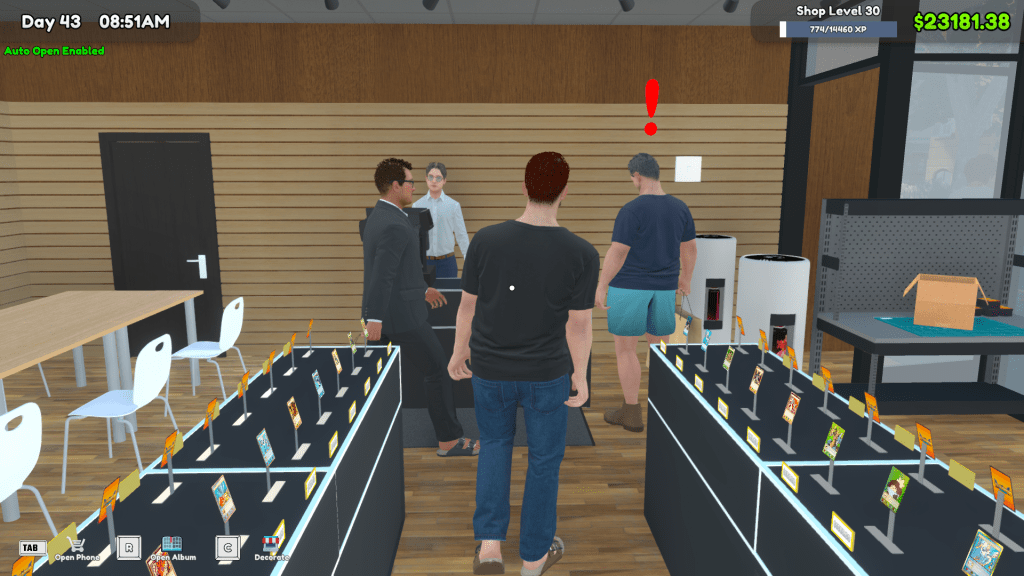
Customer card trading opportunities scale with shop level and time of day, starting at 3% base chance plus additional percentage based on progression. Morning hours cap trading at 5%, while evening peaks at 15%, and night hours drop back to 8% maximum. Advanced shops can achieve 20% trading rates during peak hours. Notably, your employees CANNOT make the decision to trade cards, only you can. So if you want to get the card trading opportunities (which, in my opinion, are some of the best margins in the game if you’re trading a high-value card) you can’t AFK the game completely.
Early in your shop’s development, customers predominantly want to sell cards rather than trade them. The trade percentage equals your shop level minus one, capping at 40% at level 40 and above. This means newer shops see very few good opportunities, while established shops get more balanced trading interactions. In my experience buying cards off of customers is WAY more valuable than trading for them.
When customers offer cards for sale, they price them between 70% and 120% of market value, with additional multipliers based on the card’s market price tier. Higher-value cards receive increasingly generous pricing multipliers, making expensive card transactions more profitable for customers.
Stink Mechanics, Crowd Control, and Automated Cleaning Systems
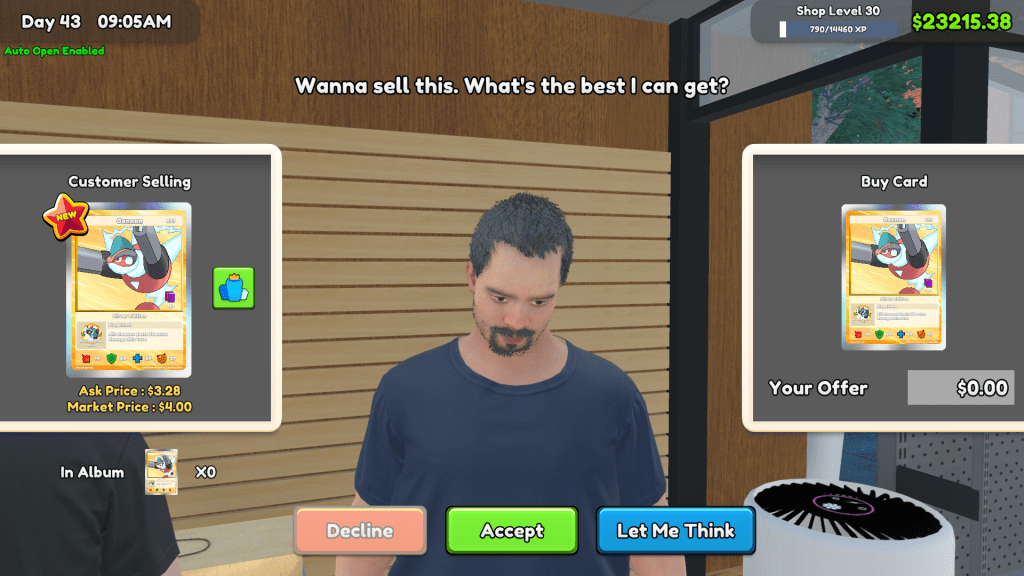
The percentage of customers spawning as “stinky” increases with shop level, starting at 2% and capping at 17% at level 31. This is to represent the fact that gamers like bigger stores, so the bigger you are the more gamers you’ll get. Evening hours add 3% to this rate, while nighttime adds 5%, creating peak stink periods that require active management. Your shop can accommodate multiple stinky customers simultaneously, with the maximum calculated based on your shop level. I feel that this mechanic in particular makes this sim highly realistic.
When stinky customers come within 3 units of clean customers, each stinky customer adds a cumulative 15% chance that clean customers will immediately head to checkout or leave entirely. This makes crowd management and strategic spraying crucial during busy periods, especially when you have multiple stinky customers present.
Manual spraying reduces stink levels by 1 point every 0.15 seconds, requiring 1.5 seconds to fully clean a customer with maximum stink. Automated sprayers work more efficiently, with small units removing 5 points, medium units removing 7.5 points, and large units completely eliminating stink every 3 seconds.
Seriously, you can easily solve this problem by forking over the money for two auto-spray contraptions in the furniture app and positioning them at the entrance so that everyone who comes in will be sprayed by both of them. Just make sure to stay stocked up on cleanser and refill the machines periodically.
Card Table Mechanics
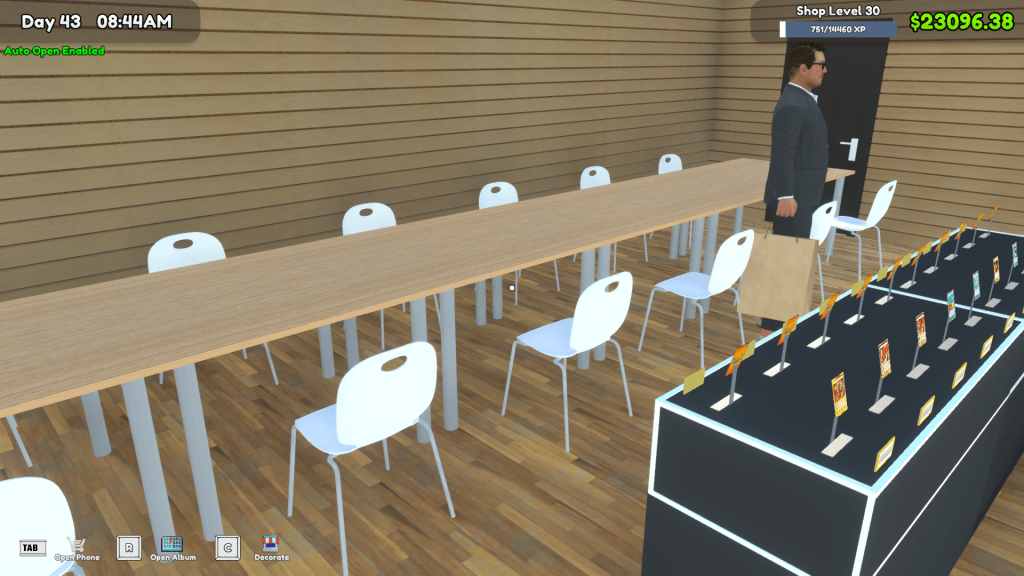
Customer interest in playing games varies dramatically by time of day, starting at 18% during morning hours and climbing to 73% at night. This percentage increases by an additional 25% when another customer is already waiting to play. After completing games, customers have a 60% chance to immediately check out, making post-game purchasing behavior highly predictable. They’re also more likely to, as of the 0.65 update, play a card game if your store’s reviews are high (the math behind this is currently unknown) and give you more XP after they’re done. But honestly… you weren’t doing card tables for the XP grind.
Lonely customers who sit alone at tables will wait 5-30 seconds before leaving due to isolation. Similarly, customers queuing for occupied tables will wait the same duration before deciding whether to buy items or try alternative activities. There’s not really a formula to decide how many tables you need, so play it by ear. I typically didn’t have more than six occupied even when ten were available.
Tournament Management
Tournaments represent one of the most reliable income sources in the game, but they require proper setup and management and aren’t as profitable as almost anything else. Customers evaluate tournament fees using similar price-sensitivity as merchandise, but they’re generally more accepting of tournament pricing. You’ll see normal participation at market rates, with declining acceptance as prices increase. I typically knock down the price fifty cents from the market rates just to keep tables stocked, and I usually pull about 10 hours per table per day regardless of the tournament being run.
The key is having enough tables to accommodate demand, especially during peak hours when customer interest in gaming can reach 70% or higher. Games last varying amounts of time, but customers who finish playing have a strong tendency to make additional purchases before leaving. That’s the money, really.
Tournament hosting also generates experience based on your store rating and shop level, making it valuable for progression beyond just direct profit. Since games involve two customers, completed matches provide double experience application, making this one of the most efficient ways to level up your shop without incurring expense. Actually, it might be the ONLY way to do that, I’d have to check.
Purchase Decision Mathematics
When customers enter your store, they follow a priority system for choosing what to examine. Target customers head directly to shelves containing their desired items, while others select random stocked compartments. Customers examining random shelves have a 33% base chance to look at card displays if available, increasing by 15% during afternoon hours and another 15% if the customer has already played a game.
If a customer initially doesn’t look for non-pack items, there’s a 75% chance the game will change it so they are looking for non-pack items, ensuring most customers leave with something when they engage with your products. Special rules apply to certain items, with deodorant having specific purchase limitations based on customer cleanliness status. But if you’ve set up the automatic cleansers, you won’t need to worry about that.
How Experience is Calculated
Customer transactions generate experience points through a comprehensive formula that rewards both quantity and quality of sales. The calculation includes number of items times 4, total item volume, sum of unlock level requirements divided by 2, and individual cards times 10. This system incentivizes selling diverse, high-level products while maintaining steady volume through smaller items.
Tournament play generates experience based on store rating, shop level, and play duration. The formula squares your average store rating, multiplies by a shop level modifier capped at level 51, and scales by actual play time in hours, then applies a 1.5x multiplier per participating customer. Since games involve two customers, completed matches provide double experience application.
Different card rarities provide varying XP amounts, ranging from 1 point for Base cards up to 144 points for Full Art Foil and Ghost Foil cards. If you’re grinding XP efficiently, focus on opening many packs rather than chasing specific rarities, since volume typically outweighs the rare high-value pulls.
Conclusion
Hopefully this guide has been helpful for you in understanding the mechanics at play!

 Amiibo Doctor