

by Doc – Owner, Founder, Does This So He Doesn’t Forget In a Few Weeks
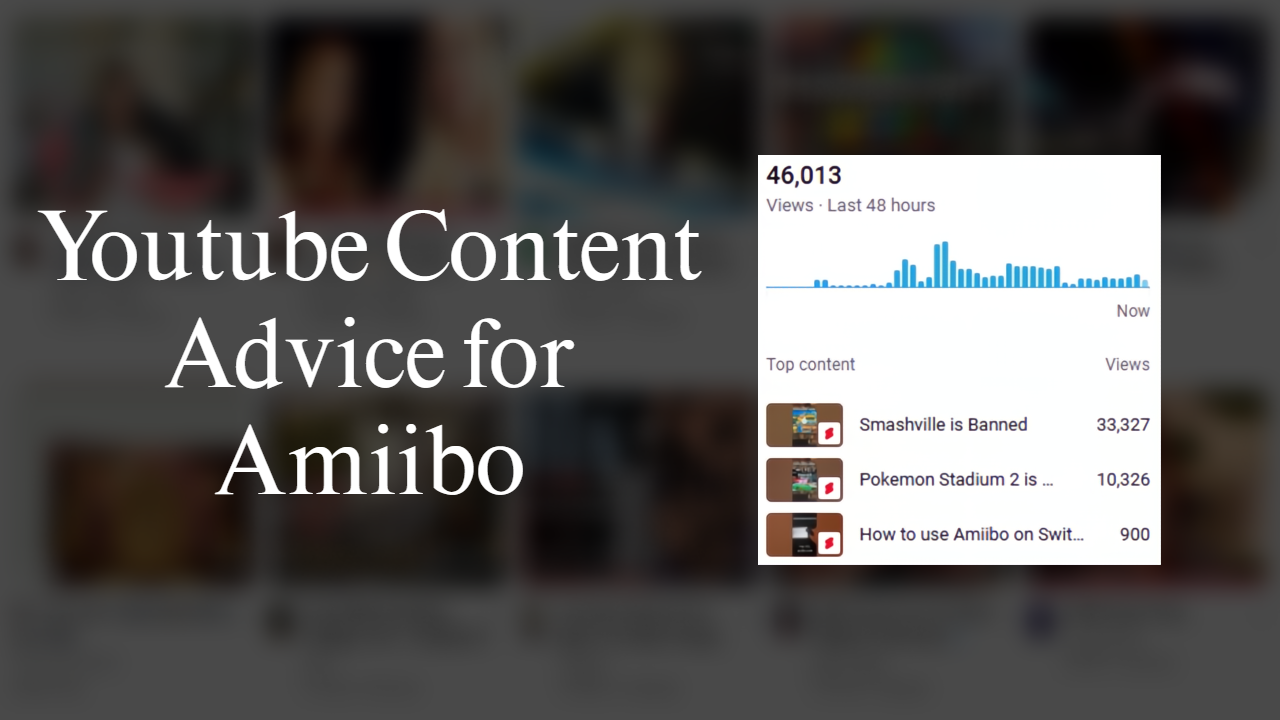
I’ve been having a bit of success lately with Amiibo-related YouTube shorts, specifically around the launch of the Switch 2. Basically, for the last few years I’ve always had a few Amiibo-related YouTube shorts that were pulling a couple dozen hits a day, so it’s not unheard of for me to have some passive traffic coming in to the tune of a few hundred hits a day on the YouTube channel, but this is an entirely new level. The last few shorts I’ve put out each hit over 10,000 views, which is an extremely large amount of traffic for anything amiibo training-related. These are simple 15-second shorts that just explain a facet of the amiibo meta with some related Smash Ultimate footage, nothing fancy.
So, really just for my own memory so I can reference this later, and for advice to anyone else trying to make Amiibo YouTube shorts and finding that the audience size is frustratingly small, here’s what I’m doing at present that is currently working quite well with the shorts algorithm.
1. I’m Not Marketing to Amiibo
If you watch some of the shorts that have really taken off lately (and by taking off I mean five-figure hits, because the Amiibo-related audience is actually very small on YouTube), you’ll notice that I talk about Smash first and Amiibo second. For example, in the Smashville one that I’ve linked you to, the first word out of my mouth is “Smashville,” not “Amiibo.” I’m showing Smash Ultimate footage and Smash Ultimate rosters in the background, but the video is actually about Amiibo. This is because on YouTube, Amiibo training is a recognized subtopic of Smash Ultimate. So why market to the smaller subtopic when you could market to the larger Smash Ultimate audience?
The hook that has always worked for Amiibo content on YouTube is that Amiibo training is an unexplored area of Smash Ultimate that features a lot of interesting and unintuitive aspects to its meta compared to the meta people are normally familiar with. There are equivalences in other old games as well: think the Pokémon Red, Blue, Yellow metagame. When you learn about the RBY meta, who do you learn are the best Pokémon? The Normal types! That’s very counterintuitive because in every other generation some other type is dominant, and that unusual information is what makes it interesting.
Well, in Pokémon generation 1, Tauros and Snorlax rule the roost. That is a content hook that makes generation 1 metagame content appeal to players of all Pokémon games, because those two Pokémon, and the other ones in the top tier, are very bad in later generations.
It’s that niche curiosity aspect that drives Amiibo content to be successful—taking someone’s interest in Smash Ultimate and presenting to them a niche that is still hopefully interesting to them.
2. Background Visual Displays
On the visual side, I have a template that I use for the back of these YouTube shorts. It’s simply the Smash Ultimate roster on that character select screen, but it’s tinted a bit, it fades in after the first 0.4 seconds, and it scrolls after a few seconds. This is so that it’s not so distracting as to take the viewer away from the video (which we don’t want because that would reduce the retention), but it also clues in the viewer that this video is about Smash Ultimate. As I said in the first section, the first word out of my mouth is Smash Ultimate-related, and having a visual cue for that as well means that it signals to Smash Ultimate fans that they’re about to get new Smash Ultimate content. So the background visual display cues them in, adds a bit of visual flair, and the subtitles and Amiibo match footage does the rest. Which reminds me…
3. Foreground Visual Displays
Unfortunately, subtitling everything has become the norm on basically every video app there is. I’m too prideful to use those subtitle programs that only show one word on screen at a time, because that’s the stupidest way to subtitle anything that I’ve ever seen, but I do manually go through and tweak the subtitles so that they have correct spelling, correct capitalization, etc. The reason I do this is because everyone and their mother uses auto-caption software when producing YouTube shorts, and that software is often wrong both in spelling, capitalization, and sometimes even in the exact word being used. Call it a hunch, but I think people can tell when someone has actually gone through and made proper subtitles as opposed to simply relying on an AI-generated subtitle, and they appreciate proper ones.
Additionally, in the foreground I have B-roll footage that is in some way pertinent to the topic. On the Northern Cave short, I have two Amiibo playing on Northern Cave. On the Smashville short, I have two Amiibo playing on Smashville. What I do is I take two of my Amiibo, video capture them playing, and because all my shorts are about 15 seconds long, I take the best 15 seconds of fighting (the most intense, combo-adjacent kind of combat) and I make that the video. The hard truth is that 80% of an Amiibo match is rather dull, because Amiibo are not attacking or defending, they’re just kind of positioning and throwing out attacks that don’t have a hope of connecting, but that doesn’t make for good content—so we put out our best 15 seconds of the match.
The background and foreground visual displays are all necessary because that’s what keeps the viewer watching. In this format of YouTube shorts, there’s basically three things for the viewer to be watching: the subtitles plus audio, the video footage, and as background static, the Smash Ultimate character roster rolling in the background. We want them to be listening to the subtitles to get the information, we’d like for them to also be watching the really cool footage, and to fill in any gaps we have that background roster.
4. Good, Succinct Information
In each video that I’ve ever done that took off in the shorts algorithm, I was basically throwing a lot of information at the viewer quickly. Most YouTube shorts that do this are really, really irritating—because they don’t shut up, and they’re too loud, and there’s no dead air. Nobody likes to be yelled at. So what I do, in a casual tone of voice, is simply state what it is that I’m going to tell them. For example, “Northern Cave may have a balancing effect on the C tier of the Amiibo meta. [Amiibo names] are nerfed by this stage. Why do you think that is?”
Since I’m making reference to information outside of the video commentary, I also showed the statistics at the top of the screen, which is useful as another distraction, and then the video loops. We like the video looping. That’s a good thing. The reason we like that is because it takes about a second and a half for a user who is intently watching a video to swipe to the next one because they just realized that it ended. That extra second and a half of retention takes you over 100% retention. So we want to give them enough information that they’re downloading it, downloading it quickly, and we’re giving it to them in a way that is succinct and casual, such that they do actually watch to the end.
To that end, this is how I structure what I say in a video:
[Noun] is [hook]. This is because [information]. [Second piece of information.]
That’s a rough timeline, but if you watch the videos you see what I’m talking about. The first word is always the noun that is the topic of the video, the hook is the piece of interesting information that is relevant to the Smash player, and the two pieces of information are expounding on it slightly. It’s in those two pieces of information that you can inject that this is about competitive Amiibo, not Smash Ultimate. Make sense?
5. Titling
This one isn’t as important, but a good title is very helpful. One thing I found over the years is that if your title consists of a relevant noun and the hook, it will benefit your video. For example, the best YouTube short I’ve ever put out is about a minute long and its title is “There’s an Amiibo meta?” The noun is Amiibo, obviously. The hook is that competitive Amiibo exists. I get a lot of traffic from YouTube’s browse features, as opposed to the shorts feed, because people read the title and think “what the heck?” In my more recent ones, the title is simply “[noun] is [hook].” I think it’s kind of funny that the most effective hooks are the ones where you simply give people 70% of the relevant information so that they have to click on it to get the other 30%. It’s also stupid, and I hate that that’s what this has come to, but hey, that’s the internet for you.
Hopefully this helps,
Doc

 Amiibo Doctor