

by Doc – Owner, Founder, Cynical
For those of you unaware, though I don’t write about them often I do spend a good chunk of time playing Steam games (though the recent Megabonk coverage probably told you that), and chief among them being Valve’s collection of excellent shooters. Though I’ve not played Counter-Strike 2, I’m well acquainted with Team Fortress 2 which features a similar skins market that has tickled my lil’ economist brain since I first began playing almost a decade ago.
The CS2 market, like Team Fortress 2, relies on players spending fixed amounts of money to open crates that have a percentage chance of granting certain digital items of varying rarities. In other words, you can gamble real money for in-game items, and the ability to trade these items for real-world money has created a secondary market that features traders, investors and a whole host of collectors who use these items in-game. This is the part in the discourse where the typical “tough guy” internet commentator would say “Haha yeah, you shouldn’t be spending money for pixels, anyway, so you get what you deserve, nerd”. I see that cynicism and raise you more cynicism.
The internet commentator has a point: they are just pixels, and they exist solely contingent on your ability to access the Counter-Strike 2 servers (or the servers of whatever game you’ve bought digital items on – TF2, Runescape, Roblox, etc.) and make trades through those servers. If you can’t make the trade, they’re worthless. If you can’t access the game, they’re worthless. Much the like NFT fad that we all knew was going to crash and burn except for the money launderers prodding it along, spending money for an intangible thing that exists dependent on someone else’s computer never, ever works out permanently. It’s not necessarily a scam, but it’s not tangible and permanent enough to be considered “property”, either. Sometimes computer servers get wiped, or accounts get hacked, or games just shut down, and then you’re out of luck.
Or, even worse, sometimes the rules of the economy that you’ve sunk so much money into just change without warning and all that “success” you’ve built up is suddenly a pile of sand. There was nothing you could do to stop it and no way to avoid having your labors blasted to bits. Such is the nature of digital items.
So What Should We Do?
Well, here’s the rub: for as long as people are willing to pay large amounts of money to essentially gamble in games, there’s going to be markets like this. This crash won’t send a message throughout the gaming community that this kind of business model is unviable – after all, gambling is a human activity that predates every country currently in existence (yes, even China and Egypt). We love to gamble. It’s built in to us.
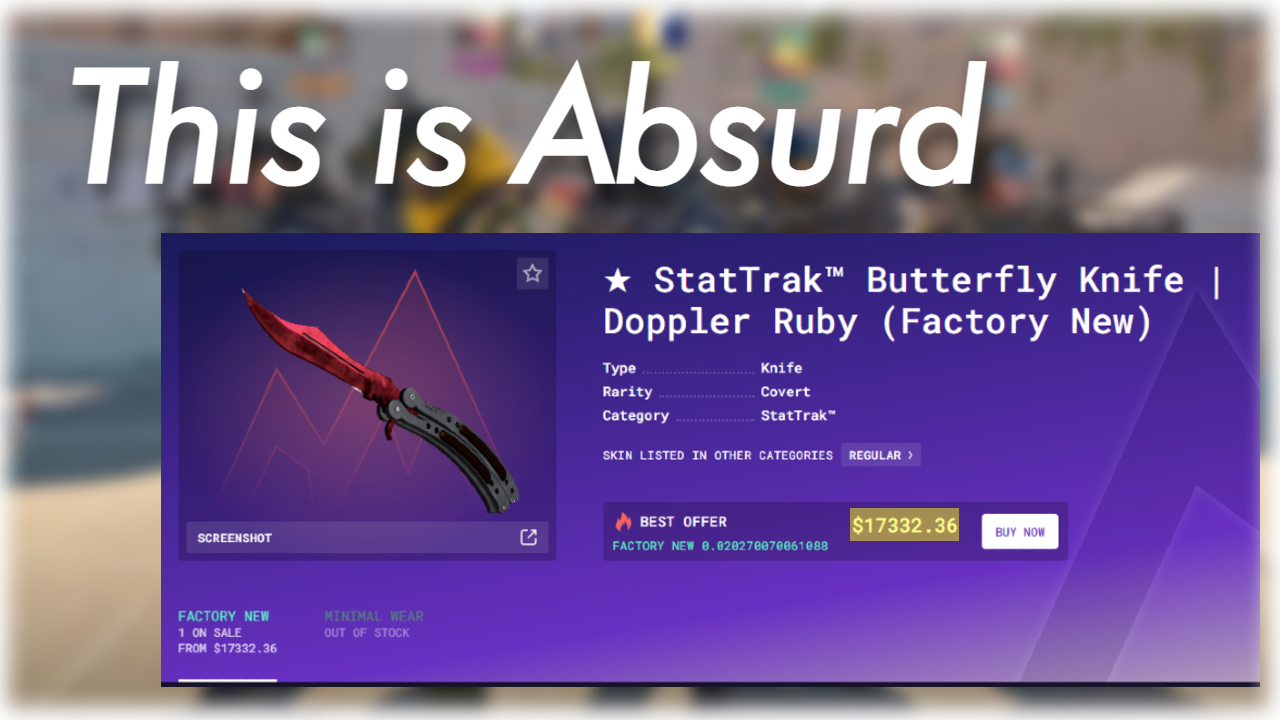
What we can do is to not support this to any large degree. There’s nothing wrong with opening a loot box now and then to support a game you enjoy. I do it myself on Team Fortress 2 periodically, just to tell Valve to keep the servers on and occasionally get a nice cosmetic if I’m lucky. But engaging in chicanery like a $1400 CS2 knife that’s expensive because it’s blue? That’s not worth the money. Everything may be worth what its purchasers will pay for it, but that doesn’t mean you should be paying for it.
I think the lesson here is one of self-control. We don’t need to be buying expensive digital items, let alone building an economy out of them if we can help it. If one arises, that’s nice, but that’s not a solid foundation to put your money into as anything beyond a small enjoyment on top of a game you already like.
Stop economizing this stuff, people. That’s really what I’m trying to say here.

 Amiibo Doctor