

by Doc – Owner, Founder, Capable of Thinking About Actual, Real-Life Things Like Markets and Such
I am not a financial advisor or otherwise qualified to give you investment advice, financial advice, or other advice in this arena.
I’ll put a disclaimer at the start of this post: I’m a capitalist through and through, and consider the optimal, ideal form of capitalism to be one that rests on top of a solid and consistent social fabric, where each agent in the economy operates by a largely similar set of Judeo-Christian morals, and a few other specific patterns of regulations included in there. I don’t think my country (the USA) has that social fabric anymore, rendering our iteration of capitalist practice to be inferior to its former practice, but some capitalist free market activity is better than no capitalism in my book. I’m not here to hash out economic political beliefs, but that’s where I’m coming from.
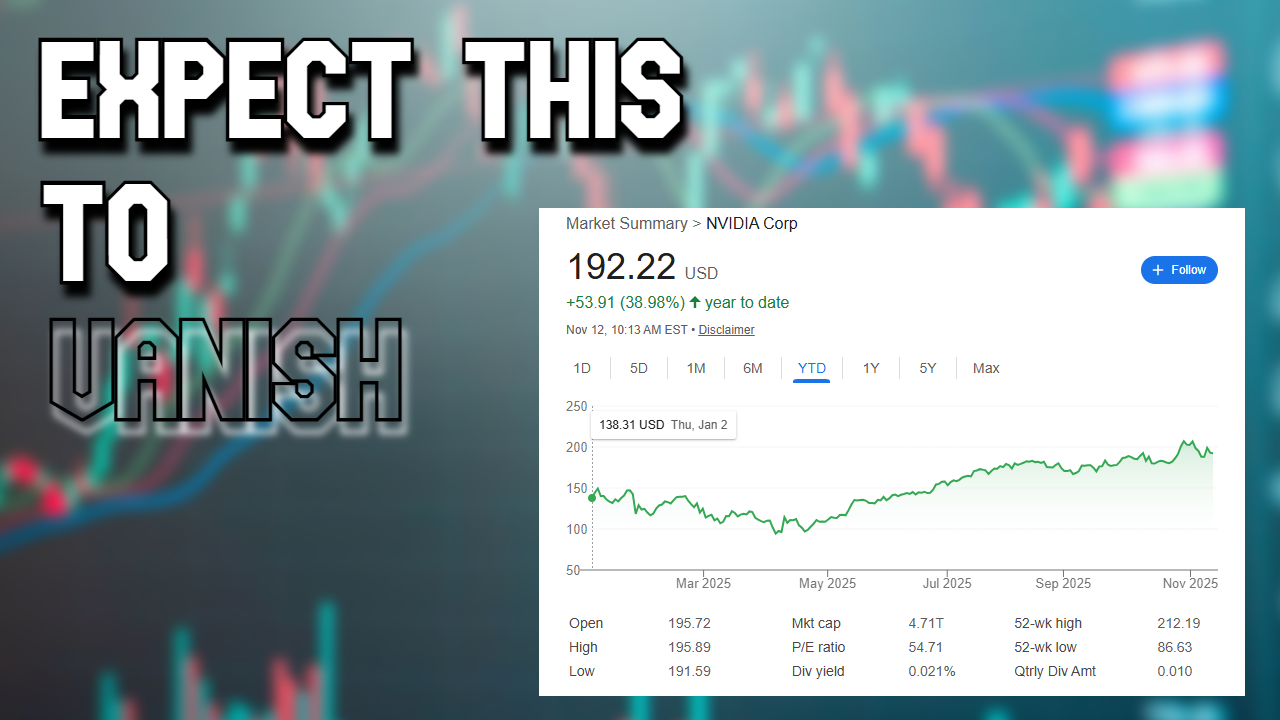
There’s An AI Bubble
It’s pretty clear, if you have training in either economics or finance as a field of study, or market history for that matter, that right now the stock exchange in many parts of the world rests entirely on the outsized growth of the AI industry. The valuation of most of the indices on which the “safe” investments operate is heavily inflated by the tech stocks that are benefiting from inflated valuations because of AI hype. And it’s pretty clear that this growth isn’t built on the sustainable fundamentals – the level of investment is logarithmically larger than the level of revenue that these companies bring in, sometimes amounting to one investment worth 100 years of revenue for that company. The markets have had a philosophy since the ’90s that it’s better to plant 100 seeds and have three of them survive to produce massive fruit the size of companies like Facebook, Google and so on than to plant 10 seeds, have eight of them survive and result in returns of only a few million dollars each. That’s an oversimplification of what you’ll find at many mutual funds and venture capital firms that make the investment calls.
The problem is that unlike previous bubbles, such as the dot-com bubble that swelled up in the ’90s and crashed in the 2000s, people’s jobs are being replaced by the tool that is the subject of the investment. Job replacement is arguably the biggest downside of capitalist practices, as companies are incentivized to innovate their product offerings, they must remove the parts of their business that don’t align with new product offerings… And of course, middlingly competent or even incompetent executives are wont to fire employees to make the balance sheet look good for that quarter, so they can cash out their investments and make a personal profit. (One of my preferred regulations is a prohibition on an executive trading in their own stock for this very reason). So firing people to replace them with AI is quite the trend right now.
Executives Have Driven This Into the Ground
Here’s the problem: labor replacement is not yet feasible through AI in many of the positions that are being fired and replaced with AI. Programmers are hit the hardest from this, but AI does not often produce code that is simple enough for a non-programmer to debug and fix. I should know! I’ve been using Claude to try to create a simple Python game that features aspects of amiibo training for a while now, and I just can’t get it to give me a good product. I’ve been working on it for 6 months, and gave up last month. Corporations are looking at AI and thinking they’ve found a cheap alternative to hiring people, when really they’re making more problems for themselves.
So what’s to be done with those empty jobs once the AI bubble bursts? Well, fortunately those people will be hired back, or at least hired in some capacity. (Of course it would preferable for them to have never been fired in the first place). There will be a resurgence in those jobs opening back up again, because those people should never have been fired in the first place, and who better to clean up the mess AI left behind than for the people who never left that mess in the first place! This will be compounded with the fact that AI will no longer be cheap to use – it’s subsidized by venture capital money flowing in, and while something like ChatGPT will probably stick around because Microsoft can’t afford to make that investment go sour, I anticipate everything else will crash and burn financially. (I mean, hopefully Claude sticks around too, it’s probably the best LLM in my opinion, but we’ll see). So when this market crash happens, the jobs will probably come back, AI will be too expensive to be feasible in most circumstances, and aside from the LLM software that you could run on a quality Nvidia GPU I don’t anticipate there will be much action from those for the next few years. I think it’ll be a nice little golden age where these fired individuals have their jobs, corporations still be assisted by AI that the company pays for, but nobody is under any delusions that this thing can replace people… At least, most people won’t be under those delusions.
Basically, it’ll get worse before it gets better, but it’ll end up like it didn’t matter much at all. Just my thoughts.

 Amiibo Doctor