

by Doc – Owner, Founder, Graded Aficionado
The fundamental unit of TCG Card Shop Simulator is not money, but time required to earn that money. This game operates in real time, not on a turn-based system or some other contrived measurement, so the effectiveness of money-making methods in TCG Card Shop Simulator should be considered relative to the amount of time that they take. Additionally, some methods become more potent as you level up, so anticipate some wiggle room on how precise this list is for you.
The Worst
Card Tables and Tournaments
In terms of raw output, card tables are without a doubt the least effective way to make money. The mechanics are pretty straightforward: first, you buy one of the $200 card tables (recent updates added a pair of $2,500 card tables that look nicer) and place it in your shop. In your phone, click the manage event button and set the tournament type and its cost. Don’t bother charging more than market value for the tournament. The type of tournament defines how much your customers will pay to play at the card table, but you also have to pay a daily fee for posting that tournament.
This method sucks because it takes up a very large amount of space in your store, it’s completely ineffective unless you dedicate most of your store to it, at which point it only becomes moderately ineffective, and unless you’ve set up at least five or six tables you typically will not be able to afford your store’s costs nor your employees’ costs. Additionally, while this isn’t strictly part of our financial concerns, it also doesn’t give you any XP! At least, not enough to make it worthwhile. At the very least, when customers are done playing the game they are significantly more likely to buy something from your retail side, so that’s nice.
Selling Miscellaneous Merchandise
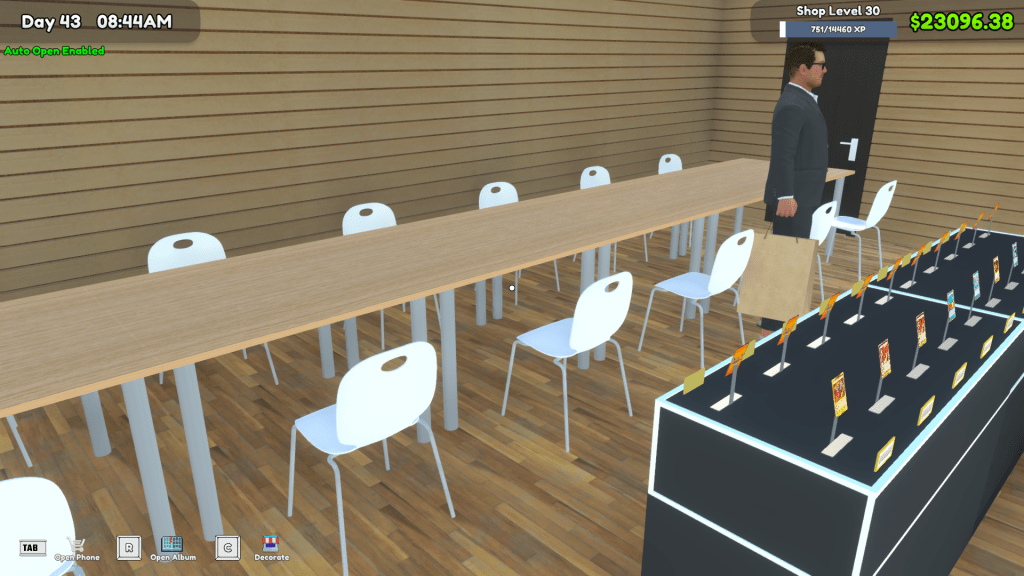
I’m cheating a little bit by breaking up selling retail into two categories – selling booster packs and booster boxes, and selling miscellaneous merchandise. I’m doing that because most of your customers are coming into the store to buy booster packs and boxes, not the merchandise, and the merchandise is significantly more tedious to stock than the packs and boxes.
Most merchandise is fairly expensive, takes up a lot of space on your shelf so you need to restock frequently when it sells out, and does not have a large enough margin to justify it over a more normal booster box or booster pack. However, recent updates have modified customer AI so that they will negatively review your store if you don’t have all of the playmats, accessories, figurines and such stocked that are available to you. Additionally, the licenses for these merchandise items are extremely expensive, with practically no real upside to stocking them besides avoiding negative reviews.
Let me be clear – you can make money from these, and so long as you’re keeping them stocked you’ll be selling them at a low volume pace. There’s just not enough margin to justify the shelf space for that low volume, so you’re really just stocking them to avoid the negative reviews.
A Note on Store Level
The following three methods all improve significantly as your store becomes more established, because customers are able to spend more money as your store level goes up. Consider these three to be your primary methods of making money.
Selling Single Cards
Half the fun of this game is opening booster packs, typically with some kind of image mod enabled to make you feel like you’re opening, say, Pokémon cards, and to see if you get anything valuable out of it. Well, single cards happen to be a halfway decent way to make money in the early game, and an actually pretty effective way to make money in the late game. They’re complicated, so let me explain the mechanics really quick.
The basics are simple: You purchase booster packs the same way you normally would, but instead of putting them on the shelf, you hold them in your hand, press R (if you haven’t changed that keybind in the settings yet) and click, and you’ll start opening booster packs. Oh, and you get a ton of XP from opening a lot of booster packs, too. So that’s nice.
Opening booster packs seems like a fool’s errand at first, because you likely won’t make enough money to pay off the booster packs (when you take into account that 99% of the cards you’re pulling won’t be worth enough to bother selling on the table – more on that later), but you’re in luck! 1% of the cards will be enough, and actually if you open enough booster packs you make quite a bit of money. Regardless of the type of booster pack, I would encourage you to open at least a hundred in every sitting if you can. Booster packs turn a profit when they’re opened by the 100, not by one at a time. And, conveniently, as you level up and get the Destiny cards, the Destiny cards tend to be worth two or three times as much as the Tetramon base set. So when you start pulling Destiny, you’ll make good money.
Each card goes into your card binder, which can be accessed with the R key, and can be placed on a card table, which costs $400 in the store. See the little gray stand sticking up from the table? That’s where you put the card for sale. Click it and grab your card from the binder, and place it on there. Then set a price, and it’ll sell.
That’s the basics of selling singles, but this mechanic has been expanded wildly. For starters, as you level up in the game not only can you hire employees who you may assign tasks to, but you can purchase pretty expensive automatic card openers after level 20. They go through and open the cards for you, and give them to you when you’re done. Conveniently, as of the 0.65 update, employees can now be set to automatically reload the automatic pack opener! So there’s no need for a fast pack open mod anymore, you can play the game normally and collect your cards periodically.
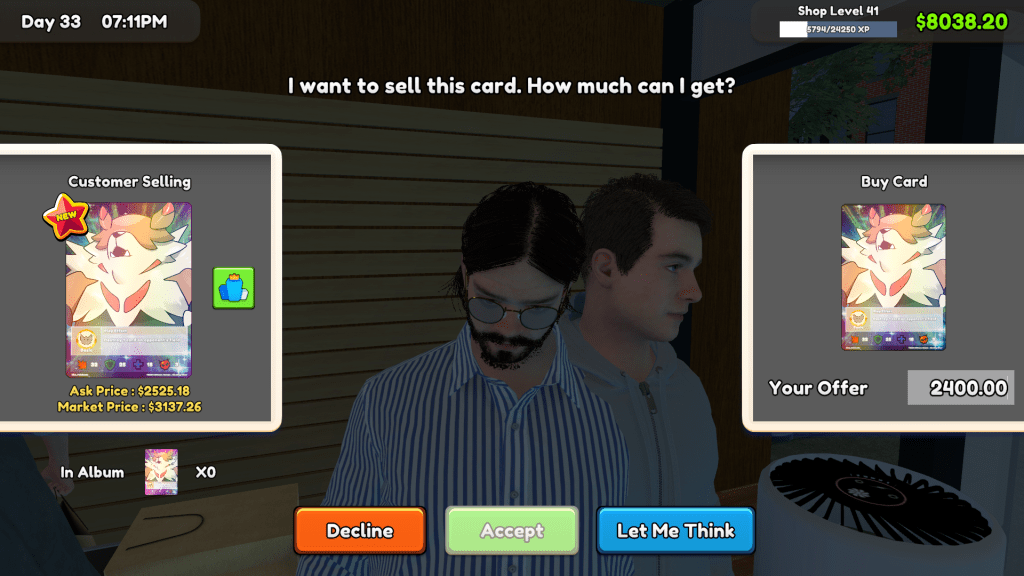
Customers will sometimes offer you expensive single cards to trade, and at a pretty good value too. They can ask for anywhere from 30% less to 30% more than the market value of that card. My rule of thumb is to input the value of 10% less than the market value of that card, and keep clicking accept until they either accept or walk away. If they accept, then I can turn around and sell that card for 10% over its market value, resulting in an easy margin of 20% on that card. Customer trades are a waste of time 90% of the time, but about 10% of the time they’ll give you something genuinely awesome.
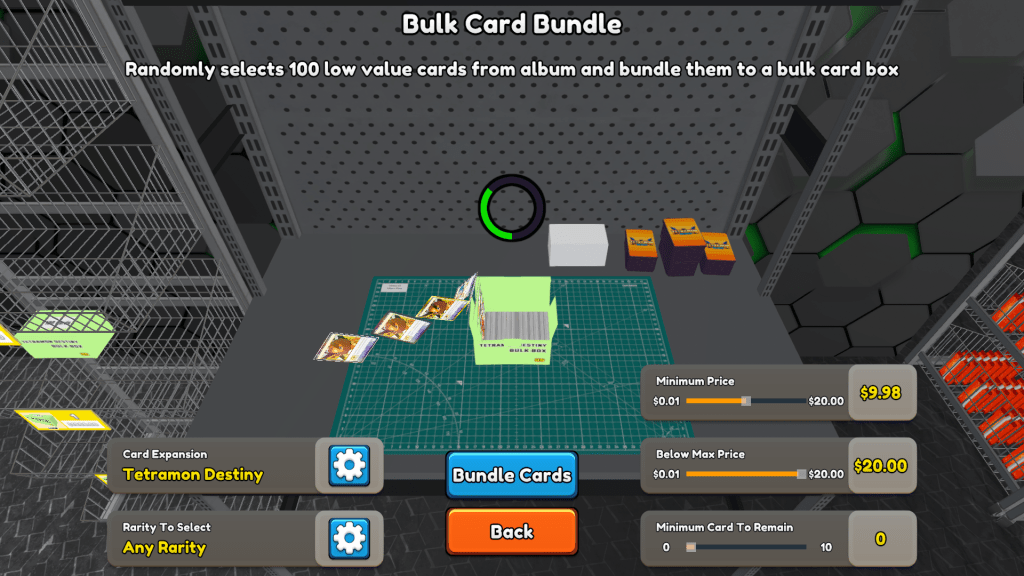
Additionally, you can collect a large amount of worthless cards whose value is too low to bother putting on a card table. These are called ‘bulk’ cards. If you pay $1,000 for the workbench, the workbench will allow you to create your own product – the bulk box – and the category of bulk box will depend on what kind of price range of cards you put into it. It’s a great way to get rid of all of the low value cards that you weren’t able to sell, and recoup that cost. I encourage you to always have bulk cards stocked.
Selling Graded Cards
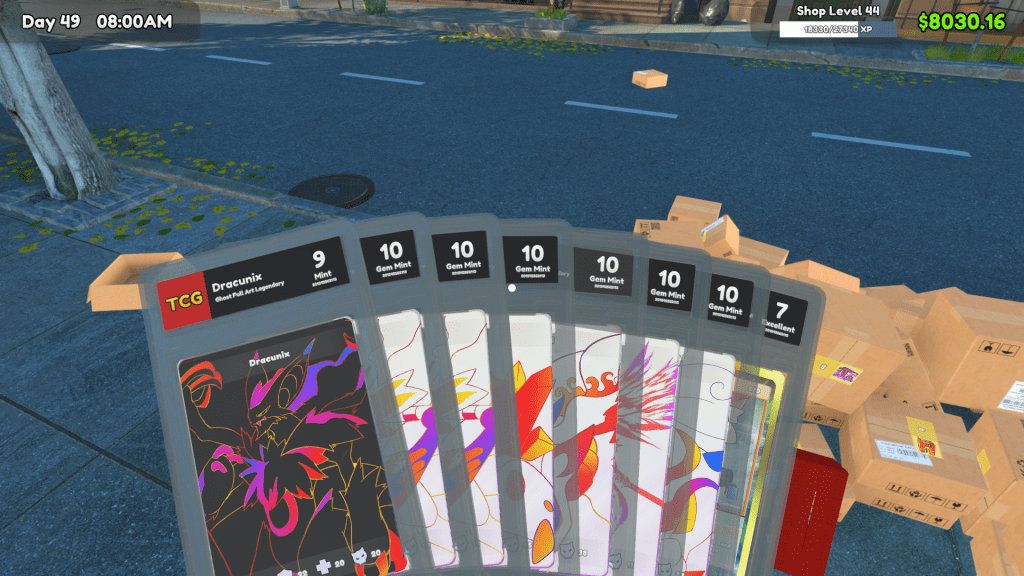
If opening packs wasn’t enough fun for you, you now have the ability to degenerate even further into your gambling addiction. That’s right – grading cards has been added! You can now take your highest value cards and throw them back into the casino to see what comes out.
Grading cards is typically a safe bet. So long as you don’t pay too much for the delivery time, you’ll typically make a nice profit on the value of the card. Don’t bother grading any cards under $500, if you are less than about level 50. If you’re over level 50, bump that up a few hundred bucks. You can only have 32 cards out for grading at a single time, so use those slots wisely.
In my experience, about 70% of the time you’ll come back with a card that is an eight, nine or 10. Tens are where the real money is made, but sales of the eights and the nines will subsidize the rest of your expenses in getting to this point. That’s why we only want to grade cards that are sufficiently expensive – if the 10 value isn’t enough to pay for the cost of grading plus the cost of the booster packs it took to get there, we don’t want to bother.
The downside of grading cards is that, not only do you have to pay for the cost of the booster packs it took to get those singles in the first place, you also have to pay for the grading with both finances and time. So I would consider grading to be an activity to start early on in your singles adventure, with the lower cost grading services that take longer, and not to spend too much money on it until you start pulling in a few $1,000+ cards every few days.
Selling Boosters and Booster Boxes
This is the core retail activity around which the rest of the game is designed and built. Most of your customers coming in are going to want booster boxes and packs, and you’ve got pretty solid margins on both of those items. The licenses for selling these are significantly more affordable than anything else in the game when you consider their expected returns, and you have an easy time stocking them and unlocking them with XP as well.
Retail is inherently easy due to the fact that you can hire an employee to do all the work, and as long as you’re keeping inventory stocked your employees will take care of the rest. That’s not something that the singles options can really say for themselves.
However, I would be remiss if I didn’t mention that while retail is a very consistent way to make money, and you’ll do fine so long as you keep everything in stock, it’s also very predictable and has no major upsides. With grading cards, you’ll sometimes make $30,000 to $50,000 on a lucky 10 grade on a ghost foil card. With retail, you are simply exchanging time for money, and can basically AFK the game at that point.
Additionally, retail is also the most expensive way to get your money, as half of your sales have to go back into product purchases. You’ll do plenty of volume, far more than enough to remove this as a concern, but you will occasionally have a tight squeeze if you try to expand too quickly. There’s little downside, but little upside as well, basically.
My Recommendation
If you’re in the early to mid-game, which is to say up to about level 30 or 35, just do retail and open a few booster packs here and there to sell the cards. If you really want to, you can do card tournaments as a way to drum up sales, but that’s not going to be your long-term endeavor.
Once you’ve unlocked Destiny packs, I’d suggest switching to singles, graded cards and continuing your retail sales. You’ll want to expand and invest heavily in your retail offerings if you haven’t already, as the consistent income from retail will subsidize the, shall we say, lucky income from single card sales. Having a core retail subsidy is what makes the fun part of the game – singles and graded cards – possible.

 Amiibo Doctor