


by Doc – Owner, Founder, Seems to Be The Only Person On The Internet Explaining This Stuff For Posterity
The Pokemon series has a history of having really bizarre rabbit holes you can go down that 99% of players don’t bother exploring, even though they’re adaptations of the Pokemon formula that could be pretty interesting. The Battle Tower. Pokemon contests. Literally all of Let’s Go Pikachu/Eevee. All these niches are deserving of their own fleshed-out explanations and experiments, and no doubt a hardcore Pokemon fan has gone into the weeds for each one. Today I am that Pokemon fan.
I’ll assume you’ve played at least one Tera Raid and are here to learn how it all works. They’re not hard to understand, just unintuitive. If you’re interested in the best Tera Raid builds, go there instead.
It’s Four Battles Joined At the Hip
A Tera Raid isn’t actually a 4v1 battle. It’s four 1v1 battles happening side-by-side, all beating up a shared boss’s HP bar with shared stat changes and status inflictions between them. The opponent selects a different move to attack each of you with and is basically playing four games at once. The only information you have about the other teammates’ battles is the Y button menu, which tells you what their status is, and also the voice commands visible in the top-left area of the screen that tell you what moves they use.
If you pay attention, you’ll notice that your teammates are also doing damage to the opponent, and occasionally inflicting statuses. Some teammates go so far as to put down Grassy Terrain or Life Dew. It’s good to know what’s going on in the other battles because it lets you know what to expect: if you have a partner with Intimidate or Arboliva, and they’ve just died, you know when they respawn that Intimidate or Grassy Terrain is going to be reused, for example. We’ll cover that later.
The turn order works like this:
- Your speed versus the boss’s speed determines who goes first in your lane. NPC partners don’t start the fight until you do.
- Priority moves still function normally. Tera and Cheers always go before everything else.
- The boss gets one turn against you for every turn you take
- All four human players can act simultaneously – there’s no waiting for turns to resolve, but NPC partners can only move once for each turn you take.
Do bear in mind that this also means stat changes work in unfamiliar ways. If the raid boss Charizard uses Ancient Power and gets the lucky stat boost, those stat increases apply to all four lanes, even though you might not see the move animation. You can check its status with the Y button to see what’s actually going on with its stats. This also means raids like Gyarados with Moxie, where he gains a +1 Attack boost for each opponent he KOes, are much harder because he’ll suddenly have wildly high Attack stats. You need to check the status frequently because you’re not going to see everything that happens in everyone else’s battle.
The Timer Is Your Enemy, But Dying Is Too
Forget the raid boss for a second – your actual opponent is that orange bar ticking down below its HP. You’ve got anywhere from 5 to 7½ minutes for most raids (event raids like Mewtwo can go up to 15 minutes, which is honestly excessive), and when it hits zero, you’re done. Dying also kills a lot of time by first removing a chunk of your remaining time, and then making you wait several seconds to respawn. Do me a favor and don’t die because dying is not a freaking option. If you’re Tera’d and you die, you don’t get your Tera back. You also get slapped by a respawn timer that starts at 5 seconds and increases by 5 seconds with each additional faint, capping at 30 seconds. So your first death costs you raid time plus a 5-second respawn. Your second death costs more time plus a 10-second respawn. You see how this spirals out of control fast.
When you’re in an online raid (even if nobody else joined), you’ve got 60 seconds to pick your move or the game auto-selects your first move. In solo raids, no such limit exists. NPC trainers don’t reduce the timer when they faint, fortunately. I almost exclusively raid offline for that reason.
At 10% time remaining, you’ll get a dramatic warning message: “You can feel a tremendous energy gathering! There isn’t much time left!” This is your last-chance alarm. If you’re not close to winning at this point, you’re probably not going to win. You get one, maybe two turns left at this point.
The Script
There’s another mechanic to be aware of. Every Raid opponent has a script where, at certain intervals of HP and/or time, they’ll use a move, which interrupts whatever else is going on. This is how the Tera Raid opponent sometimes gets to attack twice in the same turn: they’ve hit an interval and everything else has to stop until they can use that move. Each opponent has a unique script, so I’d encourage you to check on them and get an idea of what you’re facing.
The Midgame Tera Shield and Terastallization
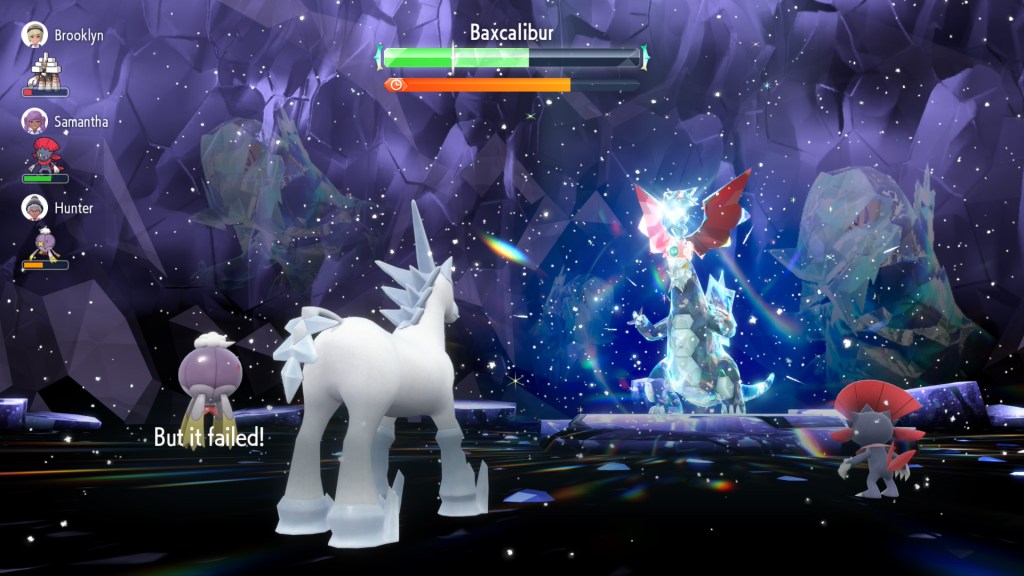
The Tera Shield
At specific HP or time thresholds (usually around 50% for both, give or take about 15%), the boss activates its Tera Shield. The Tera Shield going up is the reason you have to Terastallize at some point in the raid. The Tera Shield is your primary obstacle in a Tera Raid, so your focus should be on preparing to defeat it.
What the shield does:
- Drastically reduces incoming damage through multipliers, to the point where not Terastallizing is not an option
- Blocks all status moves targeting the boss (they just fail outright)
- Cures any non-volatile status condition the boss has when it activates
The shield has two separate triggers – one based on HP percentage, one based on time percentage – but it can only activate once per battle. Whichever threshold gets hit first is when it goes up. This is why you’ll sometimes see shields pop up at full HP: your teammates died so many times that the timer hit 50%, forcing the shield to activate despite the boss being healthy. Yet another reason to raid offline.
If you’re not sure whether you’re going to take enough HP fast enough to outpace the timer, just see whether you’re doing about 1/15th of the HP bar for each hit and also keeping the HP bar at a lower value than the timer. If you’re doing that kind of damage and outpacing the timer, you’ll be fine.
Shield Damage Multipliers
Tera Shields reduce incoming damage by a multiplier based on whether your move is Same Type Attack Bonus (STAB)-matching with your Tera and if you’re Terastallized. Below are the multipliers for 6-star Tera Raid shields:
Paldea Region multipliers:
- No Tera: ×0.2
- Terastallized, non-STAB move: ×0.35
- Terastallized, STAB move matching your Tera Type: ×0.75
Kitakami Region multipliers:
- No Tera: ×0.3
- Terastallized, non-STAB move: ×0.6
- Terastallized, STAB move matching your Tera Type: ×0.85
Indigo Disc multipliers:
- No Tera: ×0.4
- Terastallized, non-STAB move: ×0.6
- Terastallized, STAB move matching your Tera Type: ×0.8
Here’s the meat: if Fighting is super effective against their Tera, you’ll want to use a Fighting-type attack, right? And you’ll want to get STAB for the better multiplier, so you’ll use a Fighting-type Pokemon. And you might as well Tera into Fighting for the STAB and for the best possible Tera Shield multiplier. It allllll lines up so that everything runs the same type it attacks with. Fighting is super effective, so pick a Fighting-type Pokemon, use a Fighting-type attack and run a Fighting-type Tera for maximum effectiveness.
Note: when the shield breaks, the boss loses its next turn for each player. It just sits there and takes it. However, if it has any scripted additional moves scheduled for that exact moment, those still fire off. The game doesn’t care that you just broke its shield – the script is the script.
How do I Terastallize?
You need to land three direct-damaging moves to charge your Tera Orb and unlock Terastallization. Status moves like Thunder Wave don’t count. Misses don’t count. And typically at least one Tera Orb charge gets stolen before you hit three attacks, so plan on doing four.
Once you’ve charged up, you can Terastallize on any turn, and Terastallization is the first thing to occur in that turn besides a Cheer. Unlike Dynamax raids where only one person could transform at a time, all four players can Terastallize independently whenever they’ve built enough charge. You only get to do it once per raid though, so don’t Terastallize if you’re at 5 HP and about to eat a Flare Blitz – you’ll faint, waste your Tera, and you can’t build it back up. At all. If you die with Tera, you’re permanently done.
Do bear in mind that Terastallization is a very long animation, and takes even longer on the Switch 1 version of the game.
Multihit moves only give you one Tera Orb charge. Yep, I was disappointed too.
NPCs never Terastallize, but if a player disconnects and gets replaced by AI, that AI will Terastallize at the earliest possible opportunity.
Status Moves and the Shield
The Tera shield blocks status moves against the opponent, full stop. If you try to use Screech or Thunder Wave or whatever while that shield is up, it fails.
BUT secondary effects from damaging moves still work. The shield only blocks status moves targeting the boss. So:
- Acid Spray lowers Special Defense even through the shield
- Chilling Water lowers Attack
- Flamethrower still burns
- …and so on.
This is one of the few ways to apply debuffs during the shield phase, and it’s absolutely worth exploiting. I’d recommend reading this list of the best moves in Tera Raids to get an idea of what you can use during this stage.
The Script, Explained a Bit More
The opponent has their turn-by-turn play but also the script that interjects periodically with additional moves. However, there’s two different movepools they can pull from. They have their base movepool, which is the four moves they’ll be hitting you with normally, and then they have their “extra action” movepool which they’ll only bust out when the script requires it.
There are six types of extra action:
0. Regular moves
You make a move. Opponent makes a move. It’s Pokemon. You get the idea.
1. Additional Move
The boss uses a move outside its normal turn order. This can be a move from its base moveset or something completely different that it won’t know when you catch it. These are scripted, so check the opponent’s script to know what comes when.
How it works:
- If it targets a single Pokémon, a random target is chosen, and everyone sees the animation
- If it’s a multi-target move (like Earthquake), it actually hits all four players and applies the multi-target damage penalty (this is the only time moves can hit multiple targets in raids)
- These moves can be interrupted by paralysis but NOT by freeze (if frozen, it delays until after thawing)
When you see these trigger mid-turn, that’s why it looks like the boss used two moves at once… because he basically did. He used his regular move and then his scripted move.
If the trigger is set at 100% HP or time, it fires immediately at battle start, before anyone can take a turn. This happens constantly in 7★ raids and some 5★ event raids.
2. Shield Activation
Covered extensively above. Just remember: it can only happen once, triggered by whichever threshold (HP or time) gets hit first.
3. Remove Negative Effects
The boss clears all status conditions and negative stat modifiers from itself. His positive stat modifiers stay intact.
4. Remove Positive Effects (also called “The Midraid Stat Wipe” by me)
This one’s nasty. The boss removes all your positive stat modifiers (leaving the negative ones) and shuts off your ability for one turn. Bear in mind that not all raids do this, so it’s important to know how much time you can invest in self-boosting before it’s going to get wiped. If it happens pretty late, boost a lot! If it happens pretty early, bide your time and don’t boost as much.
What survives:
- Light Screen and Reflect
- Terrain effects (Misty Terrain, Electric Terrain, etc.)
- Weather effects (Rain, Sun, etc.)
- Knocked out Pokémon aren’t affected (because they already lost everything)
The Ability nullification only lasts one turn, then your Ability comes back. Lucky you.
5. Tera Orb Charge Stealing (Steal)
The boss removes one charge from your Tera Orb. If you’ve already Terastallized, have zero charges, or are knocked out, this doesn’t affect you.
Since you need three charges to Terastallize and most 6★ raids steal once, you’re actually landing four hits before you can transform. Plan accordingly.
6. Double-Action Phase (7★ Only)
After hitting a specific threshold, the boss gains a percentage chance to use a second random move at the end of each turn. The move selection is completely random – it can pick moves the target is immune to, unlike normal AI behavior.
This has only appeared in 7★ raids so far, and it’s as chaotic as it sounds. The boss just decides “I’m feeling spicy” and throws out extra attacks.
Cheering: Your Emergency Button
Each player gets three cheers per raid. They have increased priority over regular moves, so they typically go first. The NPC in the first slot (top of the display order) always uses “Hang tough!” on turn 1, then never cheers again.
The Three Cheers:
Go all out! (Attacking boost)
- Multiplies Attack and Special Attack by ×1.5 for the user and all allies
- Lasts 3 turns
- Independent from normal stat modifiers
Hang tough! (Defense boost)
- Multiplies Defense and Special Defense by ×1.5 for the user and all allies
- Lasts 3 turns
- Independent from normal stat modifiers
Heal up! (You’ll never guess what it does)
- Removes non-volatile status and confusion
- Restores 20% to 100% of max HP (random, but same amount for all participants)
- Can save runs when everything’s gone sideways
The Cheer Exploit
Here’s some cheese: if you’re buffed by a cheer and you faint while the buff is active, the buff becomes permanent when you respawn. And yes, this can stack with another cheer afterward, which can also become permanent if you faint again. Obviously we want you to avoid fainting, but if you think you’re going to faint, use a cheer!
Do bear in mind that cheer buffs are multiplicative with regular stat changes, not additive. So a +3 Attack boost combined with Go all out! is multiplicative stacking.
NPC Trainers
If you don’t have four human players, NPCs fill the empty slots. They’re programmed to be mostly unhelpful, but at least they don’t reduce the timer when they faint. Don’t sweat the NPCs too much, as only a few are worth keeping an eye on. I’ve compiled NPC partner info here that’ll tell you what each NPC does that’s helpful.
NPC specifications:
- Level: 80% of your Pokémon’s level, rounded down
- Nature: Hardy (neutral – no stat changes)
- EVs: 252 HP / 128 Def / 128 SpDef
- IVs: 31 in everything except Attack and Special Attack (those are 10)
- They use one Hang tough! cheer on turn 1, then never cheer again
NPC RNG
“Challenge alone” raids use a limited RNG seed with 101 possible NPC party combinations. “Challenge as a group” raids (even if you play alone) use full 64-bit RNG and can generate any combination. Once you play one group raid, all subsequent solo raids will use that same NPC team until you restart the game. So if you get a good NPC roll, you can lock it in by doing one group raid first. That’s a lame strategy, but use it if you have to.
Special Move Interactions
Some moves just don’t work in raids, period. Generally, if the move has some kind of effect that would otherwise defeat the purpose of a drawn-out battle against an opponent with a lot of HP, it’s not going to work.
Completely fail:
- Self-Destruct, Explosion, Misty Explosion, Final Gambit (boss won’t use them either)
- Guard Split, Power Split, Perish Song
- One-hit KO moves (Fissure, Horn Drill, etc.)
- Pain Split
- Destiny Bond (did you really think it would?)
Work differently:
- HP-halving moves (Super Fang, Nature’s Madness) don’t halve the boss’s HP
- Transform/Imposter: if the boss has Imposter, it transforms into the host’s Pokémon
Capture and Rewards
When you win, the raid boss de-Terastallizes and you select a Poké Ball. The capture cannot fail – you can use a Poké Ball, a Master Ball, whatever you want. It’s guaranteed. If you’re not the host, you still get to catch it.
The boss returns to its original level when caught (6★ raids at level 90 drop to level 75). Hidden Abilities are possible from 3★ raids and up, with Ditto raids always having their Hidden Ability.
Now that you’ve learned how Tera Raids work, you should check the Tera Raid builds tier list and start building!
Additional Technical Details
Things I couldn’t fit cleanly into the main explanation:
Infinite PP: The raid boss has infinite PP on all moves. It will never Struggle.
Field effects and turn counting: Weather and terrain last a set number of turns, but those turns only decrement after all four players have taken an action. So if one player is slow, the weather sticks around longer from their perspective.
Light Screen/Reflect: These use the reduced doubles damage multiplier (×0.66 instead of ×0.5) because the game treats this as a multi-battle scenario.
Paralysis and freeze: Additional moves can be interrupted by paralysis but not freeze. If the boss is frozen when it tries to use an additional move, the action is delayed until it thaws.
Stat stage visibility: You can’t always see what the boss is doing in other lanes, but if it uses moves that change its own stats (Calm Mind, Ancient Power), those changes apply universally. Check with Y button to see its actual stat stages.
Callouts: Pressing Minus gives you four callout options (“Help!”, “Everyone, attack together!”, etc.). They do nothing mechanically but let you communicate. You can use three per turn before they lock out. Don’t bother.
Running away: Only possible in true solo raids (not opened to others). If you’ve opened the raid to online, running isn’t allowed and gives you a message about not finding an opening.
Critical hits and accuracy: The RNG is still active. You’ll miss with 95% accuracy moves. You’ll get crit. The boss will get crit. Paralysis will proc four times in a row when you need to move. This is Pokémon, so expect stupid RNG.
And that’s genuinely everything I’ve learned about how this system works. It’s complicated, it’s poorly explained, and half of it feels like it was designed by different teams who never talked to each other. But once you understand the mechanics, you can at least fight back against the chaos.

 Amiibo Doctor