

by Doc – Owner, Founder, Kind of Mind-Blown By What Democratizing Programming Has Done For the Video Game Industry
What if I told you that a video game company once took its fans’ creations, turned them into official products, brought the fans into the creation process, and walked away with untold billions of dollars? Given the state of the current video game market, you would think I’m crazy. Why would a company capitalize on its fans’ creations when those creations threaten the IP?
Yeah, well, that company is Valve. Valve has made billions of dollars off of those fan creations, and it cost them practically nothing to do. Keep this example in mind as you read on.
As you’ve seen, fan-made content has exploded in the last several weeks thanks to AI tools mashing up existing game franchises and sometimes going farther than that. Naturally, the video game industry shrieked in horror when they were reminded that fans like to fiddle with software, and Microsoft subsidiary Activision began legal action before CEO Satya Nadella stepped in. Taking a page from Valve, Microsoft has now announced a recompilation laboratory to see what can be done with this kind of content.
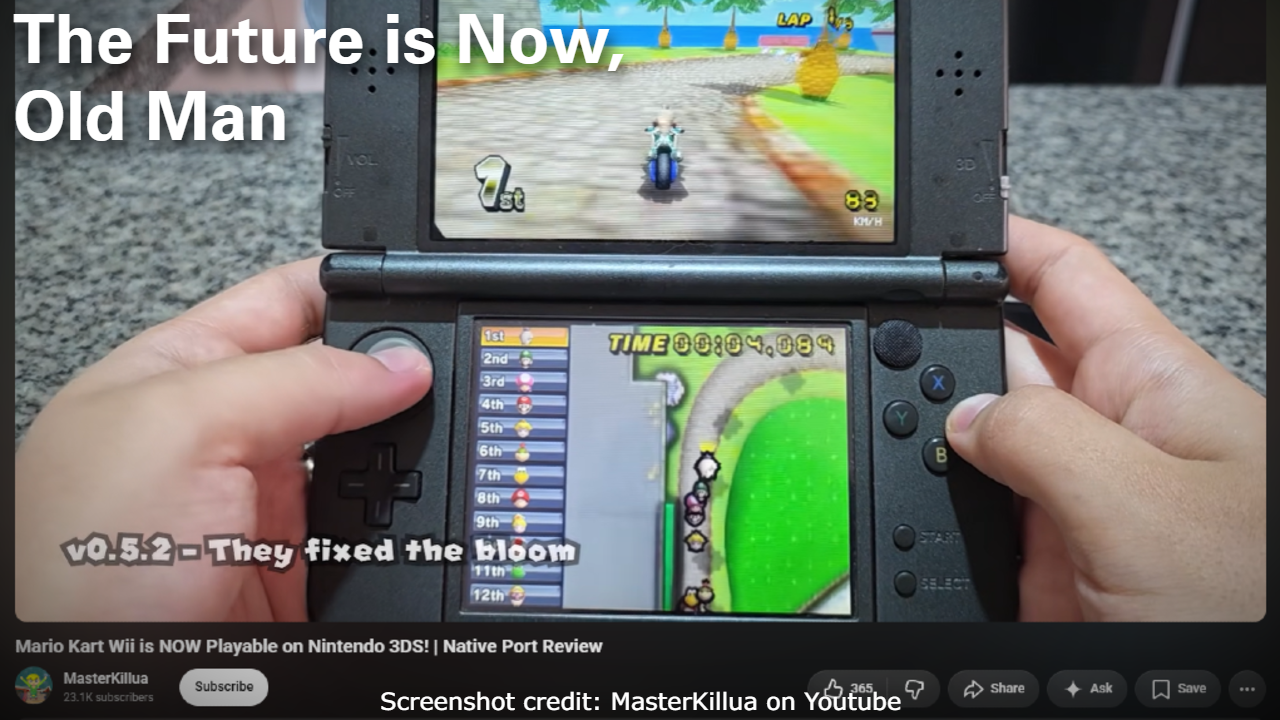
Everyone and their freakin’ mother is going to be playing or making recompilations of software, and that includes video games. Nintendo’s legacy software is old enough that it may take a few more steps than something like Halo, which already had half-PC Xbox releases. But Nintendo software will be decompiled, and I would be shocked if by June of 2027 almost the entire first-party Nintendo library hadn’t been made playable on PC in some way. As long as we have consumer AI at this strength available for sale, people will be doing this and there’s no stopping them.
If you’re Nintendo, you probably have three specific concerns:
- Will this cannibalize my existing market of video game offerings?
- Will this prevent me from successfully re-releasing decompiled games on my platforms?
- Will this corrupt public perception of my intellectual property?
These are all very valid business concerns, and nobody can fault Nintendo for having them. Nintendo does not have an obligation to embrace the desires of its fans unless doing so would benefit the shareholders, and as Nintendo has shown over its history, it is a shareholder-first company. Nintendo cares only about surviving, not the video game industry, and certainly not the video game industry’s fans.
But are these concerns founded? And if they are, do they outweigh the benefits that decompilation could bring to Nintendo? I think they are somewhat well founded but overshadowed by the potential benefits.
Cannibalizing Existing Market Offerings
Decompilation is the logical successor to emulation, and emulation has been Nintendo’s primo target for a long time. For the uninitiated, emulation is where somebody figures out how to mimic the functions of a piece of hardware with a piece of software, and then adds the file of a video game to that software so that it can be played on a platform other than its original one. Emulation has existed for decades, with some of the earliest NES emulators appearing on PCs in the 1990s.
Nintendo’s theory on emulation has been that it cannibalizes their existing market offerings, and that any IP they’re currently selling that has a game being emulated somewhere is costing them a game sale from that new IP. It’s debatable how true this is. The video game market is extremely vast and historied, and to be frank, I have never heard of somebody deciding to emulate an old game instead of purchasing a new one. Rather, consumer behavior seems to be that gamers who are introduced to a current video game series often do so by emulating or purchasing an older entry from years back. Emulation, if anything, preserves the intellectual property and its place in the consumer imagination.
Decompilation is the heir to this circumstance. I’m sure Nintendo will have similar feelings about decompilation as it did about emulation, but I think we all know that playing an old game only serves to ingratiate you to new entries in the IP.
Preventing Decompiled Games From Successfully Re-releasing on New Platforms
The video game industry for a long time was moving toward the home console becoming an “everything box” that could not only play video games, but also browse the internet, watch YouTube or Netflix, and in some cases order a pizza. This peaked around the Wii era, after which consumers no longer wanted an everything box out of their home console and instead just wanted to play video games.
The dirty secret here is that the home PC is already an everything box that also plays games, so why do people buy home consoles? PC gaming communities have joked about this for a long time, but the question is valid. There’s economically no point in buying a home console for $500 when a home PC for that same price can play most games up through the Nintendo Wii (and once the AI bubble pops and GPU prices go down, $500 will get you a lot more!).
So why do people do it? They do it because they like the form factor and how it feels to use a console! It’s the same reason people buy nicer cars that aren’t as reliable but feel better to drive. It’s a matter of feeling, not logic. This form factor feeling is what Nintendo has focused on more and more over the years as its consoles compete with the everything box. Why do you think the Wii still feels so cool to use? It’s because there’s no similar experience on a PC. The same goes for the Wii U and its GamePad, or the Switch and Switch 2 with their slender Joy-Cons.
So would people buy re-releases of decompiled games on future platforms? Of course they would! They want the form factor and the feeling of using a Nintendo product. Besides, Nintendo has been re-releasing games that are easily emulated for years, and that doesn’t seem to have hurt game sales either.
Will This Corrupt Public Perception of Nintendo’s Intellectual Property?
This one is the thinker of the three, but Nintendo has done reasonably well at targeting ROM hacks and fan creations that corrupt its IP too much. (By corrupt, I mean transforming the intellectual property from something aimed at its demographic into something more sexual, violent, or otherwise prurient.) Nintendo doesn’t take the time to legally attack every ROM hack, but it does target the ones that focus particularly on sexual content, and that has been its standing practice for many years.
I think that’s the right balance, and I don’t imagine Nintendo will have any reason to stop that practice. At the end of the day, Nintendo is a company with tens of millions of dollars of marketing resources at its fingertips, whereas a fan-made corruption would be nothing more than a flash in the pan at worst. Nintendo has worked very hard to cultivate the image it has, and I don’t think even a handful of decompilation projects can seriously threaten that.
So What Are the Benefits of Decompilation?
Nintendo has already demonstrated through Nintendo Switch Online that it is more than willing to re-release old content at heavy discounts to sweeten the value for the customer. I’ve had a $20-a-year Nintendo Switch Online subscription since Smash Ultimate came out, and with it I’ve played through several old games that I could just as easily have emulated. Decompilations only make that easier. They open games up to running on other platforms that Nintendo does not own but can still sell on, such as the mobile market. They make it easier for Nintendo developers to go back and fix bugs in old games, or add content to better align the history of a series with its modern iterations. Decompilation brings the same benefit to Nintendo that it brings to fans: it opens up the backend of old Nintendo games to tinkering and editing as necessary, without having to spend millions of dollars of employee time learning arcane, obscure technical processes.
The Fans Love Decompilations
The virality of this development tells me that fans love decompilations. I’m in a few Discord servers centered around them, and many of these have grown from a few dozen players to thousands over the span of a few days, as news of a new PC port hits the media or makes its rounds on TikTok. This phenomenon is only a few weeks old, and hundreds of old games have already been decompiled and recompiled, with most of them ported to PC. I know Nintendo is a company that zigs where people zag, but Nintendo does not embrace its fans. Valve is also a company that zigs where everybody zags, but Valve embraced its fans and is now one of the most loved companies in the industry for it. If Nintendo fails to capitalize on this within the next two to three years, I think it will miss a lot of potential for growth as a company. It won’t kill ’em, but it’s sure going to be a mistake.


