

by Doc – Owner, Founder, Glad Melee Already Went Through This
For most of my life I’ve been a fan of taking old games not designed for serious, full-time competition and turning them into esports. Super Smash Bros. Melee was my first love in this respect, and it has since grown to include all kinds of speedruns, all the Pokémon generations, and eventually amiibo training. The premise is what interests me most: you’re taking a closed, unpatchable and unchanging system and innovating it to the absolute extreme. There’s just something inherently cool about that from a game theory perspective.
With decompilations, all of these games are infinitely more accessible than they ever were, able to run on a laptop or phone, use any kind of controller input or visual update imaginable, and potentially implement online features with advanced functionality like rollback. This is a major leap forward for a lot of the old games that previously haven’t dealt with this. The Street Fighter 2 Turbo community, for example, may see it necessary to fix the game engine’s random frame dropping. But other SFII Turbo players might think that’s unfaithful to the game they’ve spent 32 years innovating. So what’s to be done with this new technology?
Well, we have a historical example to follow. Super Smash Bros. Melee has already handled a lot of the “what’s to be done with new tech?” question as of a few years ago. Before COVID, every Melee tournament I ever went to was physical and in-person. You either played on a GameCube with a Melee disc or on a Wii that had been homebrewed to play it, and everybody played on GameCube controllers with the occasional B0XX user. If you weren’t willing or able to shell out the money for all of that, you couldn’t practice or compete in Melee. It was a real problem for a long time, because those consoles were only completely lag-free on old CRT televisions, and the quality of GameCube controllers had been deteriorating rapidly since their launch, with no new GameCube controllers produced for over a decade until Smash 4 on the Wii U came out. Even then, the new controllers weren’t as good as the old ones, and the quality of your controller actually matters quite a bit when playing vanilla Melee as it may hinder you from performing 1-frame inputs that are needed to compete at top levels.
When COVID hit, it was like all of that changed on a dime. Suddenly, mods and infrastructure that had existed to enable online play in Dolphin became mainstream, and tournaments were held exclusively online. The timeline is a bit fuzzy in my memory, but I remember the community suddenly going from in-person tournaments to online Slippi and never going back. Don’t get me wrong, there’s a real pleasure to in-person Melee, but playing on computers enables visual and gameplay mods, online mods, controller input mods like UCF that equalize controller quality, and bug fixes that don’t detract from the intended experience. Melee suddenly became a fair game that didn’t require spending a ton of money, and it did so with technology.
From an outsider’s perspective (I no longer play Melee), it seems to me like the Melee community had a few unwritten rules about how it implemented these improvements. These are the rules I think other eSports should follow when debating how to handle themselves in the age of decompilations and their ability to modify the game from the ground up.
Faithfulness to the game
Texture packs and menu fixes are fine, but the base game of Melee is defined by the characters, hurtboxes, hitboxes, and all other gameplay mechanics that actually make Melee Melee. Those gameplay mechanics have to be exactly, 100% preserved for it to still be Melee. If you change the frame data of a move, or fix a bug, or change a stage so it doesn’t have an unintentional hazard anymore, that’s no longer fully vanilla. There has to be a real faithfulness and dedication to continuing to innovate the same set of game mechanics instead of replacing them with what the Melee community may wish it could have been. Stick with the girl that brung you, as they say.
This dedication is kind of obvious, because if the community is allowed to start introducing new mechanics or tweaking existing ones, then how does everyone agree on what game they’re even playing? You may try to play the official Nintendo version of the game and master a certain character, but if all of the tournaments are running slightly different versions of the character, then what have you actually gained from it? You can’t play in those tournaments, because they’re not faithful to the game. So faithfulness to the game is paramount.
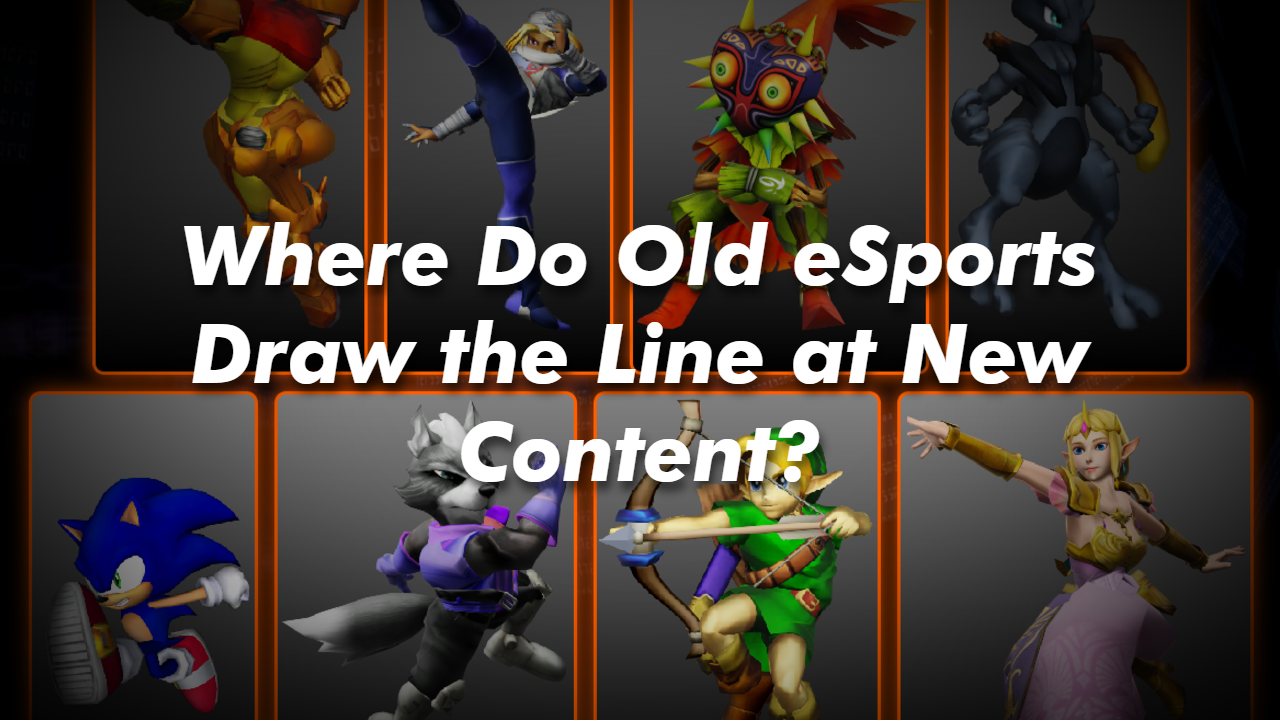
That’s one of the things I like about the Melee community, by the way. Do you see the featured image for this article? Sonic, Skull Kid and the other non-Melee characters are from Beyond Melee, one of the coolest mods for Melee that I’ve ever seen. But I don’t think I ever heard anyone suggest that Beyond Melee should replace Melee as an eSport. It’d be cool if Beyond Melee was a side event here, and it seems like the kind of thing that would be an interesting add-on to the meta, but it’s not Melee.
Equalize the game
Many of these old games depend on some real-world physical factors, with different kinds of controllers being the most frequent example. Melee adopted the Universal Controller Fix (UCF), which equalizes the dash back window and shield drop inputs so that controllers with lower-quality analog sticks or signal relays can perform the same mechanics that higher-quality controllers can. I don’t have consistent pricing data on what top-quality GameCube controllers cost before this fix became the universal standard, but I’ll bet it saved a lot of people a lot of money when preparing for a Melee tournament.
And why wouldn’t you want the game to be fair anyway?
Accessibility and training
In line with the above principles, digitizing the game is often the logical conclusion of expanding it to everyone. Hardware is expensive, but software is cheap. Legalities of emulation aside, being able to play the game on a computer you already own, with your only new expense being a suitable controller, makes the option of your esport much more palatable to potential newcomers.
One of the more common aspects of Melee mods is a training mod that lets you repeat the same muscle memory movement over and over until you get it right. I remember when I first started trying to grind out waveshines, I downloaded a hack pack that would reset to the standing position every time I failed a waveshine until I got it correct. The most waveshines I ever pulled off consecutively was four, by the way. No, I still didn’t have good neutral game. Tools like these should be encouraged in all decompilations so that players can push the game farther than they ever have before.
Visuals and quality of life
Texture packs, handicap-accessible visuals, and removing flashes are all useful visual changes that don’t have to impact the base game if done correctly. Brawl did this for years. Even if the base game was exactly the same, you’d see texture packs of Pokémon Stadium, for example, with a Master Ball in the middle instead of the normal Poké Ball. They also changed the music on Smashville so it had songs that weren’t hot garbage. These were all cosmetic changes, but they improved quality of life quite a bit.
Other mods speed up the process of, say, starting a match or unlocking items for use in the game. Smash 4 Wii U mods often came with all custom moves automatically unlocked, so tournament hosts didn’t have to grind out unlocking each character and their 400 customs.
I still want Nintendo to make Melee HD, though.
It’s okay to improve the game, but only if everyone agrees on it
I realize this conceptually counters my first point about faithfulness to the base game, but there are times in a community where everybody overwhelmingly agrees that a change should have been implemented if it could have been, and now it can be. Stages are a good example. In Smash 64, many tournaments ran a modded version of the game that turns off the wind on Dreamland 64. Dreamland 64 is the only legal stage in Smash 64 across most rule sets, so taking off the wind prevents the stage from unfairly deciding who wins and who loses.
Melee and Brawl have this as well: both have “Frozen Stadium” mods that disable the transformations on Pokémon Stadium. Without Pokémon Stadium’s transformations, the default stage is the only stage, and it’s actually quite a fair stage to play on. It’s so fair that Small Battlefield came out in Ultimate and was basically the same concept. Frozen Stadium mods are still fairly faithful to the base game, but by trimming out unfair and uncompetitive content, they refine the competitive integrity of the game. I think situations like that, where the entire community agrees it’s acceptable and it’s measured to be the minimum necessary change to preserve competitive integrity, are useful changes for decompilations to make.
There needs to be a central authority
Most esports and competitive games have some kind of central rulemaking board. Each Smash game, each Pokémon generation’s ranking, and many other competitive gaming ventures have a central authority for exactly this reason. If at all possible, esports should convene in some kind of structured but legally informal manner to advance the improvements of the esport. These institutions can call the shots on which version of the game should be used, what rule sets should be used, and, once the game has reached decompilation status and can receive extra content or patches, what patches should be installed to maintain legality with the system.
The core function of this group is maintaining coherency. Above all else, everybody needs to be playing the same version of the same game at its base mechanics. Otherwise you’ll have plenty of splintering, and splinters tend to fade away due to lack of interest and competition. For the survivability of the esport, everyone has to stick together.


